

Quick answer
A stairlift fitted by a competent installer and serviced once a year is safe equipment. The safety features that matter are the seatbelt, obstruction sensors on the carriage and footrest, a swivel seat that locks at the top, and a key or child lock.
People commonly get two things wrong. First, weight limits are specific to each model and often drop as the staircase gets steeper. No single figure covers every stairlift.
Second, a stairlift isn’t a fire escape route. At around 0.1 metres per second it’s far too slow. Anyone who can’t manage the stairs unaided needs a plan made in advance. Working it out during a fire is too late.
We don’t sell or fit stairlifts. Quotes go to UK suppliers.
Quotes are free. We’re only paid if you buy: the supplier we introduced you to pays us a fee. How we are funded
Free, no obligation • UK-based suppliers only
Key facts
- There is no universal stairlift weight limit. Published limits on current UK models range from 125kg to 160kg, and on several models the limit falls as the stair angle rises.
- Stairlifts run from a sealed rechargeable battery pack, typically 24 volts, charged through a mains transformer. They are not powered by AA cells. AA or AAA cells go in the remote handsets.
- Because the lift runs from batteries, it keeps working in a power cut. That is a different question from whether it should be used in a fire.
- A folded stairlift takes up very little of the staircase. Published folded widths on current models run from about 310mm to 344mm, so a properly parked and folded chair leaves most of the stairs clear.
- A stairlift travels at around 0.1 metres per second. A single storey takes roughly half a minute of travel, before you add sitting down and fastening the belt. It is not a means of escape.
- Fire and rescue services offer free home fire safety visits, and they prioritise people over 65 and people whose mobility affects their ability to get out.
- One person at a time. Stairlifts are designed to carry a single user.
Are stairlifts safe?
Yes, with two qualifications that matter more than any feature list.
Installation and servicing come first. A stairlift is a powered machine fixed to your staircase, so it’s only safe if it’s fitted correctly and kept maintained.
UK stairlifts are built to BS EN 81-40:2020. That standard covers stairlifts and inclined lifting platforms for people with impaired mobility. Manufacturers specify servicing at least annually, and warranty cover usually depends on it. Our stairlift servicing guide and our installation guide cover both.
The second is suitability. A stairlift is safe for someone who can sit down, stay seated, fasten a belt and stand up again at the other end. It is much less safe for someone who cannot reliably do those things, and no feature compensates for that. This is what an occupational therapist assessment is for, and it is free through the NHS or adult social care.
The equipment is rarely the problem. The mismatch between the equipment and the person is.
Weight limits are model-specific
This is the single most commonly misstated fact about stairlifts, and getting it wrong has consequences, so it is worth setting out properly.
There is no industry-wide weight limit. Each model publishes its own, and on several models the figure reduces as the staircase gets steeper, because a steeper angle puts more load through the drive. These are manufacturers’ published figures, read on 25 September 2026.
| Model | Published maximum user weight |
|---|---|
| Access BDD Flow X | 125kg |
| Acorn 130 | 127kg standard, 159kg on the HD version |
| Handicare 1100 | 140kg at 30 to 45 degrees, 130kg at 46 to 50 degrees |
| Stannah Siena, straight | 160kg |
| Stannah Siena, stairs with turns | 120 to 135kg depending on angle |
| Stannah Starla, straight | 120 to 160kg depending on angle |
| Stannah Starla, stairs with turns | 120 to 135kg depending on angle |
This has two consequences. A figure quoted for a straight staircase may not hold for the same model on a curved one.
If the user is near the upper end of any of these limits, get the limit for your specific staircase angle confirmed in writing at survey. A general figure won’t do. Heavy-duty models rated to 25 stone and above exist for exactly this reason. Our heavy-duty stairlifts guide covers them, and our stairlift specifications table puts published figures side by side.
If you have been given a single number for all stairlifts, ask again.
What the safety features actually do
The seatbelt
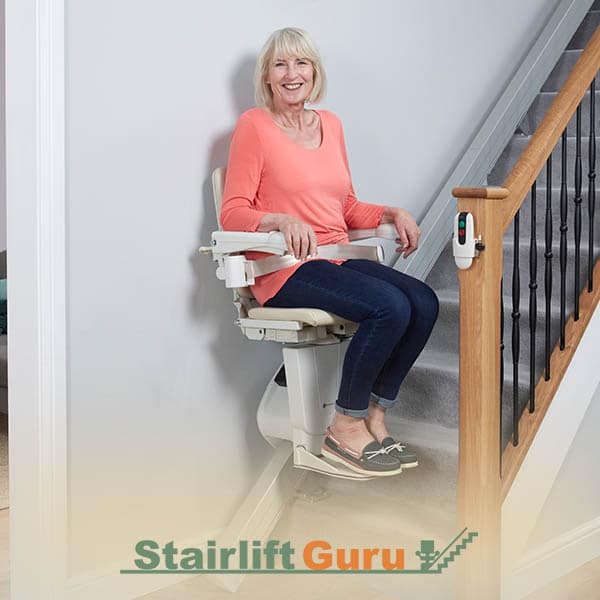
Every current model has a seatbelt, but the type varies. Across the UK range you’ll find lap belts, retractable belts, diagonal belts and five-point harnesses.
On some models the lift won’t move until the belt is fastened. Stannah states this for its range. Some manufacturers sell an immobiliser belt that works this way as a specific option.
Is the user likely to unfasten the belt partway up? Then ask about that feature directly. Don’t assume it’s fitted.
Obstruction sensors, sometimes called safety edges
The sensors sit on the carriage and on the footrest, above and below. They stop the lift when they meet something, such as a shoe left on a tread, a pet or a walking frame.
The major UK models have them as standard, though the layout differs, so check what yours has. If the lift stops unexpectedly partway, it’s usually a sensor doing its job. Look at the stairs first before suspecting a fault.
The swivel seat
At the top of the stairs the seat turns to face the landing, so the user steps straight off onto the landing floor, away from the stair treads.
On most models the seat locks at set positions, commonly 45 and 90 degrees, and on many it only works at the top. Powered swivel is an option across much of the range. Know this in advance: in a power cut, a powered swivel usually has to be worked with the manual lever.
The key or child lock
A key or child lock prevents the lift being used by someone who should not be using it. Relevant in a house with grandchildren, and relevant where someone with dementia may use the lift without help. Our page on stairlifts and dementia covers that situation.
The battery pack and the diagnostic display
The lift runs off a sealed rechargeable pack, typically 24 volts, charged by a transformer plugged into an ordinary socket. This is why it works in a power cut. The display shows codes when something is wrong, and our fault codes reference sets out the published tables. A beeping lift is usually a charging warning, not a fault, and our guide to a beeping stairlift covers what to check.
Speed
Most models travel at around 0.1 metres per second, up to 0.15 on some. That is deliberately slow, which is a safety feature in normal use and a limitation in an emergency.
Getting out in a fire
This is the part most stairlift pages skip or get wrong, and it deserves plain treatment.
Do not plan to escape on the stairlift
At 0.1 metres per second, a typical single-storey rise of about 2.6 metres takes around 26 seconds of travel. Then add sitting down, doing up the belt, swivelling and standing up at the other end. For someone who moves slowly, that’s well over a minute.
In a house fire, smoke and heat build up much faster than that. Smoke also rises, so a slow ride down through the stairwell exposes the person to the worst of it.
The standard advice applies: get out, stay out, call 999. If someone can get down the stairs on their feet in an emergency, even slowly and with help, that is faster than the lift. The lift is for everyday use, not for escape.
Does a stairlift block the escape route?
Usually not, if it is parked and folded properly, and this is where a bit of care pays off.
Published folded widths on current models run from about 310mm on the Acorn 130 and 320mm on the Handicare 1100 to 339mm on the Stannah Starla and 344mm on the Siena. On a staircase around 800mm to 900mm wide, a folded chair leaves the majority of the width clear for someone to pass, including someone carrying a person or working in poor visibility.
Unfolded is a different matter. With the seat down, footrest out and armrests up, a chair fills most of a narrow staircase. The footrest is the part that catches feet.
Three habits help most. Park the chair at the top or the bottom, never halfway. Fold the seat, armrests and footrest every time. And keep the stairs clear of the things that tend to pile up on them.
Sometimes the chair has to park at the bottom, and the foot of the stairs is also the route to the front door. If so, ask the installer about a hinged or retractable rail section. Most manufacturers offer one, and it’s there to keep a doorway or passage clear.
It’s best raised at survey, before anything is fitted. If the staircase is part of a protected route in a flat or a converted property, discuss it with your building control team too. Our stairlift regulations reference covers the standards framework.
If the person cannot get out unaided
This is the situation that needs a plan made in advance, and there is a formal process for it.
Fire and rescue services use a person-centred fire risk assessment for people whose circumstances don’t fit the usual advice. Guidance developed under the National Fire Chiefs Council framework sets out what it looks at.
Do the person’s circumstances make a fire more likely to start? Would they recognise one and react? Could they escape?
The escape question looks specifically at people who are bed or chair bound, rely on mobility aids, or move slowly. It also covers anyone who couldn’t easily unlock the front door to get out.
If escape isn’t realistic, the assessment looks at protecting the person where they are, without assuming they’ll evacuate.
That can lead to interlinked smoke alarms, or alarms suited to sensory impairment such as strobe or vibrating-pillow types. Other measures include fire-retardant bedding, personal water mist systems and fire-safe ashtrays where someone smokes.
It may also mean keeping doors closed at night to slow the spread of fire, and making sure exits aren’t locked in a way that traps someone.
The NFCC’s home safety position statement, published in December 2025, states that people with restricted mobility due to old age or long-term health conditions are more likely to be injured or killed in fires. That is the reason this is worth acting on.
Book a free home fire safety visit
Fire and rescue services across the UK offer these visits free, and households with a stairlift are usually in the priority group.
Hampshire and Isle of Wight Fire and Rescue Service is one example. It states its visits are free and focused on the most vulnerable. Its criteria include being over 65, having a mobility impairment that affects the ability to evacuate, and having a cognitive condition such as dementia. People of any age who meet the criteria can get a visit.
A visit typically covers spotting risks, fitting working smoke alarms and carbon monoxide detectors, and helping build an escape plan. Fire-retardant bedding is provided where needed. Some services offer British Sign Language and dementia-friendly visits.
Search for your own service by name and ask for a home fire safety visit or a safe and well visit. It costs nothing, and it is the single most useful thing on this page to act on.
Five things to settle before you need them
Agree who will help the person out at night if there’s a fire, and how. Decide where the stairlift key lives, so a lock never holds anyone up. Check the smoke alarms are interlinked, so an alarm going off downstairs is heard upstairs.
Keep the stairs clear, with the chair folded and parked out of the way. If the person sleeps upstairs and can’t manage the stairs on foot, tell the fire service directly. That’s exactly the situation the person-centred assessment exists for.
Everyday safe use
One person at a time, always. Stairlifts are designed and rated for a single user, and the published weight limits assume that.
Fasten the belt every journey, including short ones. Keep feet on the footrest, never trailing. Check the stairs are clear before setting off. Keep the chair folded and on charge when not in use, which both keeps the stairs clear and stops the batteries running down. Have it serviced annually, and keep the paperwork, because warranty cover usually depends on it.
Do not attempt repairs, and do not open the carriage covers. Manufacturers are explicit that work by anyone other than an approved engineer can void cover, and on at least one model the manufacturer states that non-original parts invalidate conformity. Call the service company.
If the person using the lift is becoming less steady on transfers, that is worth an occupational therapist review before something happens. Our fall prevention guide covers the wider picture.
Frequently asked questions
What is the weight limit on a stairlift?
It depends on the model and often on how steep your stairs are. Published limits on current UK models range from 125kg to 160kg, and on several the figure falls as the angle rises. Ask for the limit for your model at your stair angle, in writing.
Can you use a stairlift to escape a fire?
No. At around 0.1 metres per second it is too slow, and a slow descent through a stairwell means more exposure to smoke. Get out on foot if at all possible, stay out, and call 999. If getting out on foot is not possible, ask your fire and rescue service for a home fire safety visit and a person-centred assessment before there is an emergency.
Does a stairlift block the stairs in an emergency?
Not significantly when folded and parked at the top or bottom. Published folded widths are roughly 310mm to 344mm, which leaves most of a normal staircase clear. Left unfolded or parked mid-flight, it is a real obstruction, and the footrest is the part that catches feet.
Does a stairlift work in a power cut?
Yes. It runs from a rechargeable battery pack, not directly off the mains. With a powered swivel seat you will usually need to use the manual lever during an outage. Our stairlift batteries page covers how far the batteries will get you, and how to register with the Priority Services Register if someone in the household depends on powered equipment.
Do all stairlifts have obstruction sensors?
The major UK models have them on the carriage and footrest, but the arrangement varies and it should not be assumed. Ask what your specific model has, and ask the installer to demonstrate them at handover.
Are stairlifts safe for someone with dementia?
It depends entirely on the person and the stage, and it is a question for an occupational therapist who has met them, not a general rule. A key or child lock is often relevant. Our page on stairlifts and dementia covers the considerations.
Can two people use a stairlift together?
No. Stairlifts carry one user at a time, and the published weight limits are set on that basis.
How often should a stairlift be serviced?
At least once a year, and more with heavy use. Manufacturers generally require it to keep warranty cover valid. Our servicing guide has the costs.
Next steps
Do two things this week. First, find your model’s weight limit for your stair angle and keep it with your paperwork. Second, book a free home fire safety visit with your local fire and rescue service. It costs nothing and counts for more than anything else on this page.
When you book, say so if the user sleeps upstairs and couldn’t get down unaided in an emergency. The person-centred assessment is designed around that situation. And if getting on and off the seat is becoming harder, ask for an occupational therapist review.
Related guides
- Stairlift batteries
- Stairlift servicing
- Stairlift installation
- Stairlift fault codes
- Stairlift beeping and not charging
- Heavy-duty stairlifts
- Stairlifts and dementia
- Stairlift regulations UK
- What an occupational therapist does
Sources
- BS EN 81-40:2020, Safety rules for the construction and installation of lifts. Special lifts for the transport of persons and goods. Stairlifts and inclined lifting platforms intended for persons with impaired mobility, BSI, landingpage.bsigroup.com/LandingPage/Standard?UPI=000000000030364301, accessed 25 September 2026.
- Home safety position statement, National Fire Chiefs Council, published December 2025, nfcc.org.uk/our-services/position-statements/home-safety, accessed 25 September 2026.
- Person-centred fire risk assessment guide, Dorset and Wiltshire Fire and Rescue Service, based on the NFCC guide 2017, dwfire.org.uk/wp-content/uploads/2019/04/DWFRS-Person-Centred-FRA-Guide.pdf, accessed 25 September 2026.
- Home fire safety visit (Safe and Well), Hampshire and Isle of Wight Fire and Rescue Service, hantsfire.gov.uk/safety/home-safe-home/safe-and-well, accessed 25 September 2026.
- Acorn 130 specification and dimensions, Acorn Stairlifts, acorn-stairlifts.co.uk/stairlift/straight, accessed 25 September 2026.
- Acorn 130 user manual, December 2020, acornstairlifts.co.uk/Acorn-Stairlifts-User-Manuals-130.pdf, accessed 25 September 2026.
- Siena stairlift, Stannah, stannah.com/our-stairlifts/siena, accessed 25 September 2026.
- Starla stairlift, Stannah, stannah.com/our-stairlifts/starla, accessed 25 September 2026.
- Handicare 1100 seat dimensions, doc V1 – 1/2017, 1stchoicestairlifts.com/wp-content/uploads/2021/12/handicare-1100-stairlift-dimensions.pdf, accessed 25 September 2026.
- Flow X, Access BDD, accessbdd.com/flow-x, accessed 25 September 2026.
How we are funded
We do not sell or install stairlifts. Quotes go to UK suppliers. If you buy a stairlift from a supplier we introduced you to, that supplier pays us a fee. Requesting quotes is free and we are not paid for the request itself. Stairlift Guru is published by Whito Ltd, a company registered in England and Wales (number 10918465), and we have no ownership link to any supplier.
How to cite this page
Stairlift Guru, “Stairlift Safety, Fire and Evacuation”, stairliftguru.co.uk, reviewed September 2026. The weight-limit table is compiled from manufacturers’ own published figures, each read on 25 September 2026. Please keep the model attached to any limit you quote, because there is no single figure for all stairlifts.
Last reviewed: September 2026. Editor: Jacob Whitmore.
Choosing a stairlift: our six guides
Independent UK guides on every stage of the decision and the install.
- Is it time for a stairlift? , The decision before you start. Signs, conversations, and what to try first.
- Types of stairlift , Straight, curved, narrow, outdoor, heavy-duty, standing. Which one fits your home.
- Stairlift prices , What stairlifts actually cost in the UK. By type, with what changes the price.
- Stairlift grants and funding , Disabled Facilities Grant, NHS, charity, finance. Who pays for what.
- Buy, rent, or reconditioned , The three routes compared, with a decision flowchart.
- Living with a stairlift , Install, servicing, repair, batteries, sell, remove. The full lifecycle.
 ChatGPT