

At a glance: A used stairlift in the UK typically sells for around £100 to £500 in 2026, depending on brand, age, condition, and whether it is straight or curved. Straight stairlifts are easier to resell than curved ones because the rail can be reused. The main routes are independent buy-back companies, manufacturer resale schemes (e.g. Acorn), charity donation, scrap recycling, and private sale.
Stairlift Guru is an independent UK service that connects you with vetted stairlift buy-back companies. We do not buy stairlifts ourselves. We may be paid a referral fee by the buy-back companies we pass your enquiry to. That never changes the advice we give or the offers you receive.

Sell Your Stairlift: Free UK Valuation and Buyer-Matching Service
Free valuation from vetted UK buyersIf a stairlift is no longer needed, selling it can help recover some of the original cost. However, not all stairlifts can be resold, and the value depends heavily on the type, condition, and how it was installed.
This guide explains whether you can sell a stairlift, what options are realistic in the UK, and when removal or disposal makes more sense.
A used straight stairlift in good working order typically fetches £100 to £500 in the UK. Curved stairlifts are harder to sell as a complete unit because the rail is bespoke, but the carriage and motor can still have value.
Selling a stairlift usually means selling the chair and motor unit, not the rail, as most rails are custom-fitted and cannot be reused.
In many cases, only straight stairlifts have meaningful resale value.
How our stairlift buyer-matching service works
1. Tell us about your stairlift. Fill in the short form below with the make, model, age and condition. It takes about two minutes and there’s no obligation.
2. We match you with vetted UK buyers. Your details go to reputable buy-back companies that cover your area and accept your brand and age of stairlift.
3. Compare offers and book free, professional removal. Written offers usually arrive within 48 hours. The buyer arranges removal, typically within 1 to 3 weeks.
What is my stairlift worth? Instant estimate
Answer four questions for a guide price based on the UK resale and buy-back ranges published on this page. No email address needed.
Typical UK offer for a stairlift like this
£150 to £300
How we work this out: we start from the type and age bands in the resale table on this page. We then adjust for the make using the brand buy-back table below, and reduce the range if the unit has a fault.
It's a guide figure and doesn't count as an offer. Real offers depend on your postcode, the rail length and what the buyer currently has demand for. Figures last reviewed August 2026.
Get a Free Stairlift Valuation
Use the form below to get a no-obligation valuation for your used stairlift. Tell us the type, make, age and condition. We’ll connect you with reputable UK stairlift buyers who can give you a fair price and arrange professional removal.
Straight stairlifts typically fetch £100 to £500, depending on age and brand. Curved ones are harder to resell, though the carriage and motor may still have value. Most sellers get an offer within 48 hours and have the stairlift removed within 1 to 3 weeks.
If you have an unwanted stairlift in your home, you have more options than most people realise. The hard part is telling fact from sales pitch. Most search results are companies competing for your stairlift, and their offers vary widely.
That’s where we come in. Stairlift Guru is an independent UK service that matches you with vetted stairlift buy-back companies. You can compare fair written offers and arrange free, professional removal in one place.
We don’t buy stairlifts ourselves. We pass your enquiry to buyers, and we may be paid a referral fee by them. That never changes the advice we give or the offers you receive.
Below is the practical playbook for selling, donating, recycling or scrapping a used stairlift in the UK in 2026. It includes realistic price ranges and the questions to ask before you commit.
UK used stairlifts typically fetch £100 to £500 for a straight unit in good working order. Curved stairlifts are harder to sell as a complete unit because the rail is bespoke to the original staircase, but the carriage and motor can still have value. The right route depends on the brand, the age, the condition, and how quickly you need it gone.
Last updated 2 July 2026. Next scheduled review: October 2026.
Want to buy a stairlift instead? This page is for people getting rid of a stairlift they no longer need.
If you're after a used one, our guide to reconditioned stairlifts covers what to pay and what to check before you commit. If you only need a stairlift for a few months, stairlift rental usually works out cheaper than buying second-hand and selling it on later.
How Much Is a Used Stairlift Worth in the UK in 2026?
Realistic 2026 UK resale ranges, fully removed by the buyer:
| Type and condition | Typical UK resale (2026) | Notes |
|---|---|---|
| Straight, under 4 years, working | £300 to £500 | Best resale prospect, rail can be cut for new homes |
| Straight, 4 to 7 years, working | £150 to £300 | Most common case for buy-back schemes |
| Straight, 7 to 10 years, working | £75 to £150 | Limited buyer pool, often free removal in lieu of payment |
| Curved, under 4 years, working | £200 to £400 | Carriage and motor sell, custom rail rarely transfers |
| Curved, 4 to 7 years, working | £100 to £250 | Often sold for parts |
| Outdoor, working | £200 to £450 | Smaller buyer pool but weather-rated parts hold value |
| Reconditioned-grade or non-working | £0 to £75 + free removal | Scrap or parts route, free uplift instead of cash |
These are real 2026 offers, not list prices. Brand also matters: Acorn, Stannah, Handicare, Brooks, and Minivator hold value better than less common brands because parts and demand are stronger.
Five Routes for an Unwanted Stairlift
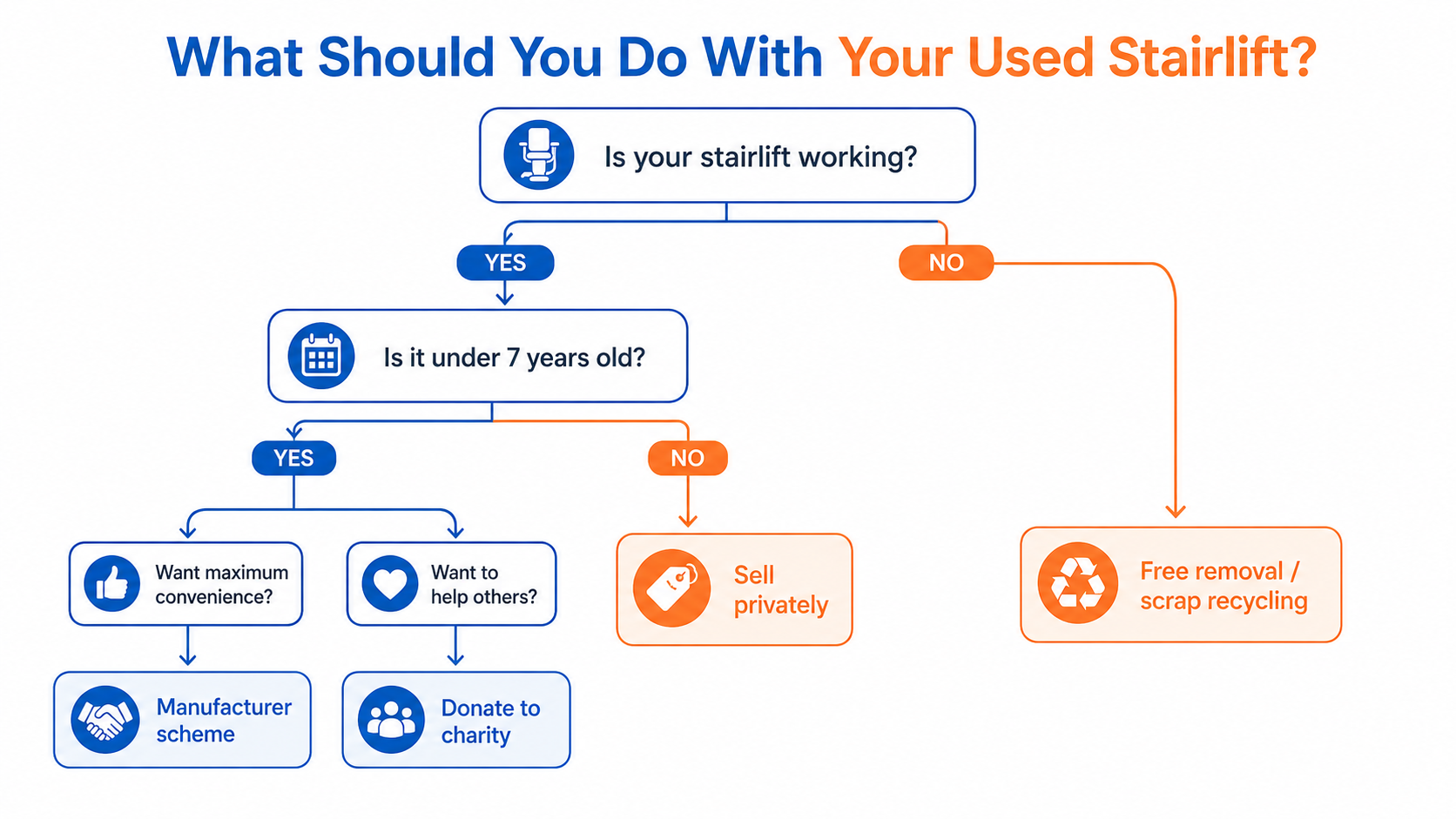
There are five legitimate routes in the UK. Each suits a different combination of stairlift age, type, and how much effort you want to put in.
1. Independent Buy-Back Service
Best for: straight stairlifts under 7 years, common brands, sellers who want it gone fast. How it works: you submit photos and details, the company makes a written offer, an engineer comes to remove the unit, you receive payment. Most pay between £100 and £400 in 2026, typically by bank transfer. We have a comparison of UK buy-back services further down this page, including which brands and ages each accepts.
2. Manufacturer Resale or Buy-Back Scheme
Best for: stairlifts originally bought from a national brand that runs its own resale scheme. How it works: Acorn, for example, helps original customers sell privately through its resale process. Ableworld offers a guaranteed buy-back on stairlifts originally purchased from them. Pricing is usually predictable but rarely the highest available, the trade-off is convenience and trust.
3. Charity Donation
Best for: straight stairlifts in good condition, where a tax-efficient or feel-good outcome matters more to you than the highest cash price. How it works: Muscular Dystrophy UK, Independence at Home and a small number of regional charities accept stairlift donations or pass them on to people who need them. Curved stairlifts are rarely accepted because the rail doesn’t transfer.
4. Scrap or Recycle
Best for: non-working units, very old stairlifts (10+ years), or anything where the resale offer is below £75. How it works: a licensed UK waste carrier collects the unit and dismantles it for parts and metal recovery. Some buy-back companies do this for free instead of paying for the unit. Never fly-tip a stairlift, it is a criminal offence under the Environmental Protection Act 1990.
5. Private Sale
Best for: patient sellers with a popular straight stairlift who can manage the removal themselves.
How it works: list it on Facebook Marketplace, Gumtree, eBay or local community boards. This usually gets you the best price. You do, though, handle the buyer questions and the removal logistics, plus the legal liability if the buyer reinstalls it incorrectly.
Most sellers find it’s more hassle than it’s worth for the few hundred pounds of upside.
How to Sell a Stairlift, Step by Step
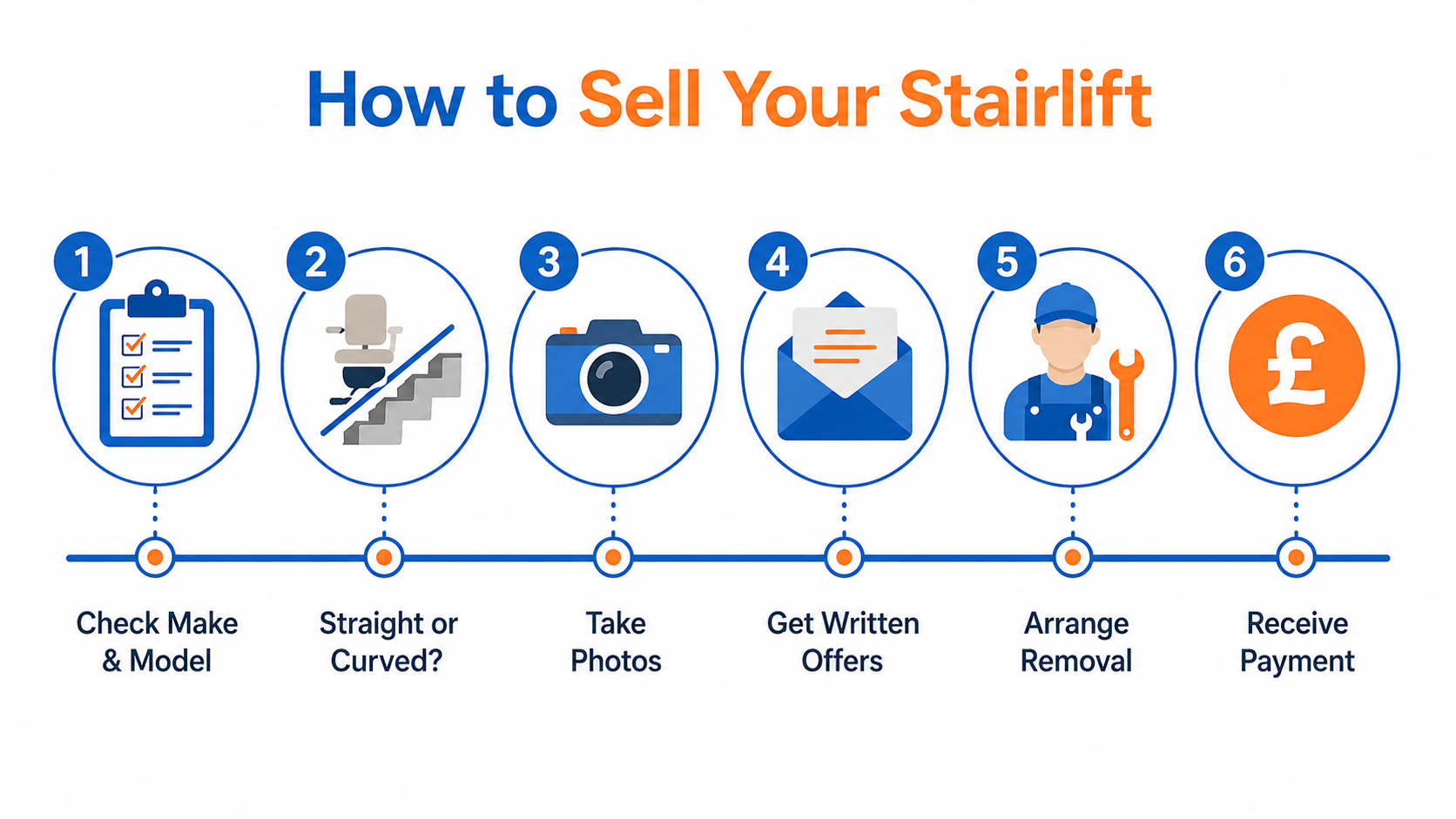
Whichever route you choose, the process broadly follows these steps:
- Identify the make, model, and age. Look on the rail and seat for a manufacturer label, or dig out the original purchase paperwork. Buyers price by brand, model, and rough installation date.
- Confirm whether it is straight or curved. Straight stairlifts have a much wider buyer pool and command higher resale prices. Curved stairlifts have bespoke rails that rarely fit another home.
- Take clear photos. Photograph the seat, the rail at both ends of the staircase, the controls, and the mounting points. Note the rail length and any optional features (powered swivel, hinged track, heavy-duty seat).
- Get two or three written offers. Compare independent buy-back services, manufacturer schemes, and at least one local stairlift dealer. The gap between the lowest and highest offer is usually £100 to £200.
- Confirm removal terms in writing. Price, removal date, who pays for removal, what condition the stairs and walls will be left in (small holes are normal), and how you will be paid.
- Schedule professional removal. Never attempt to remove a stairlift yourself. The carriage is heavy, the rail is wall-mounted, and the battery system needs careful handling. Removal usually takes one to two hours.
- Take payment and keep the paperwork. Bank transfer is safer than cash. For scrap routes, confirm the company holds a UK waste carrier licence and keep their reference number.
What to Expect During Stairlift Removal
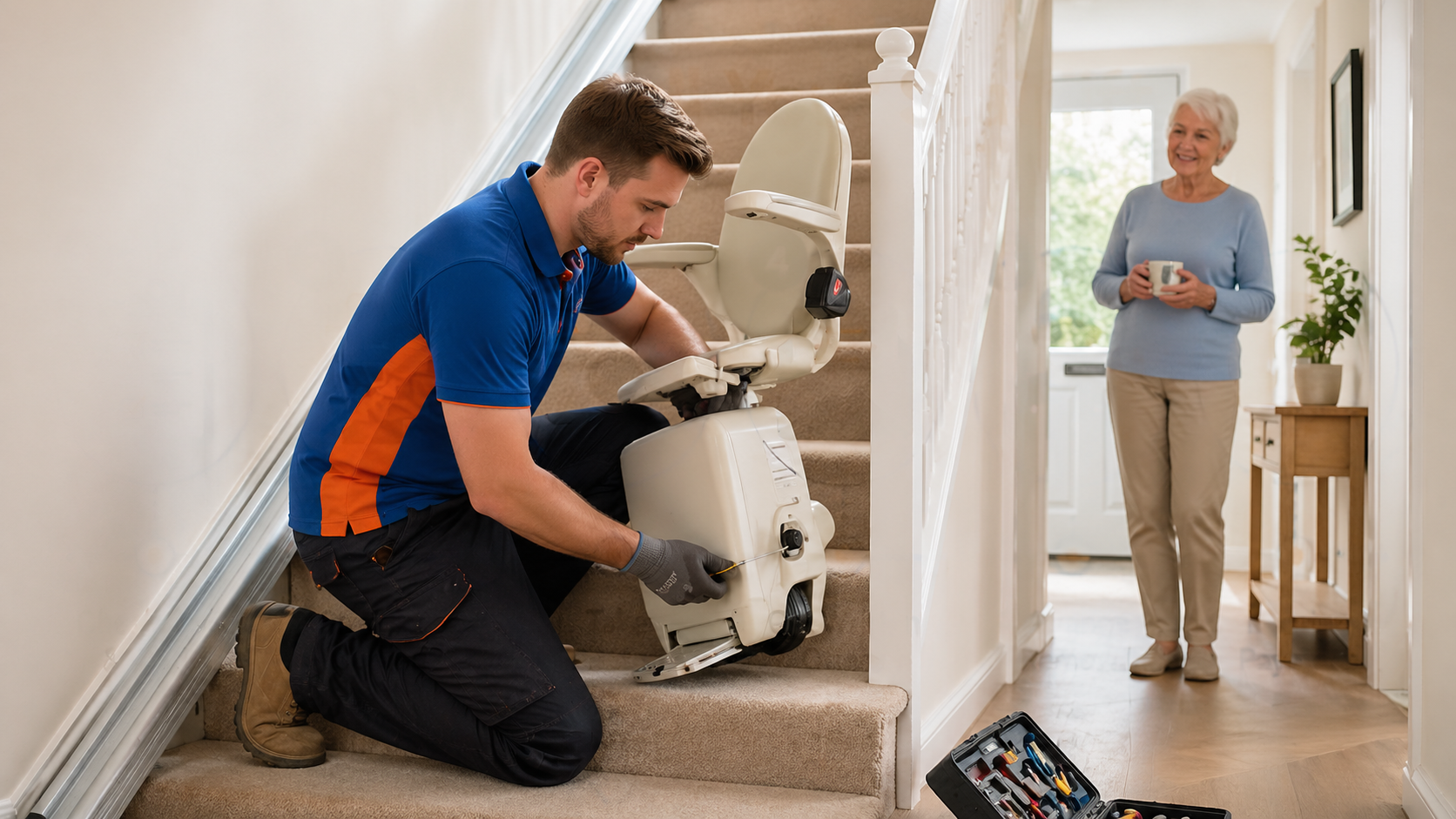
Whether you sell through a buy-back company, a manufacturer scheme, or arrange private collection, removal follows a similar process in most cases.
A qualified engineer arrives at the agreed time, disconnects the battery system, unbolts the carriage from the rail, then removes the rail sections from the wall and stairs. The whole process typically takes one to two hours for a straight stairlift and two to three hours for a curved installation.
Expect small fixing holes in the wall where the rail brackets were mounted, and possibly minor marks on a few stair treads. Most engineers will fill the most visible holes with filler, but repainting is usually your responsibility. This is standard across the industry, not a sign of a careless job.
If you are arranging removal as part of a buy-back, confirm in writing beforehand who is responsible for making good afterwards. Some companies include basic remedial work in their service, others do not.
What Actually Affects the Resale Value
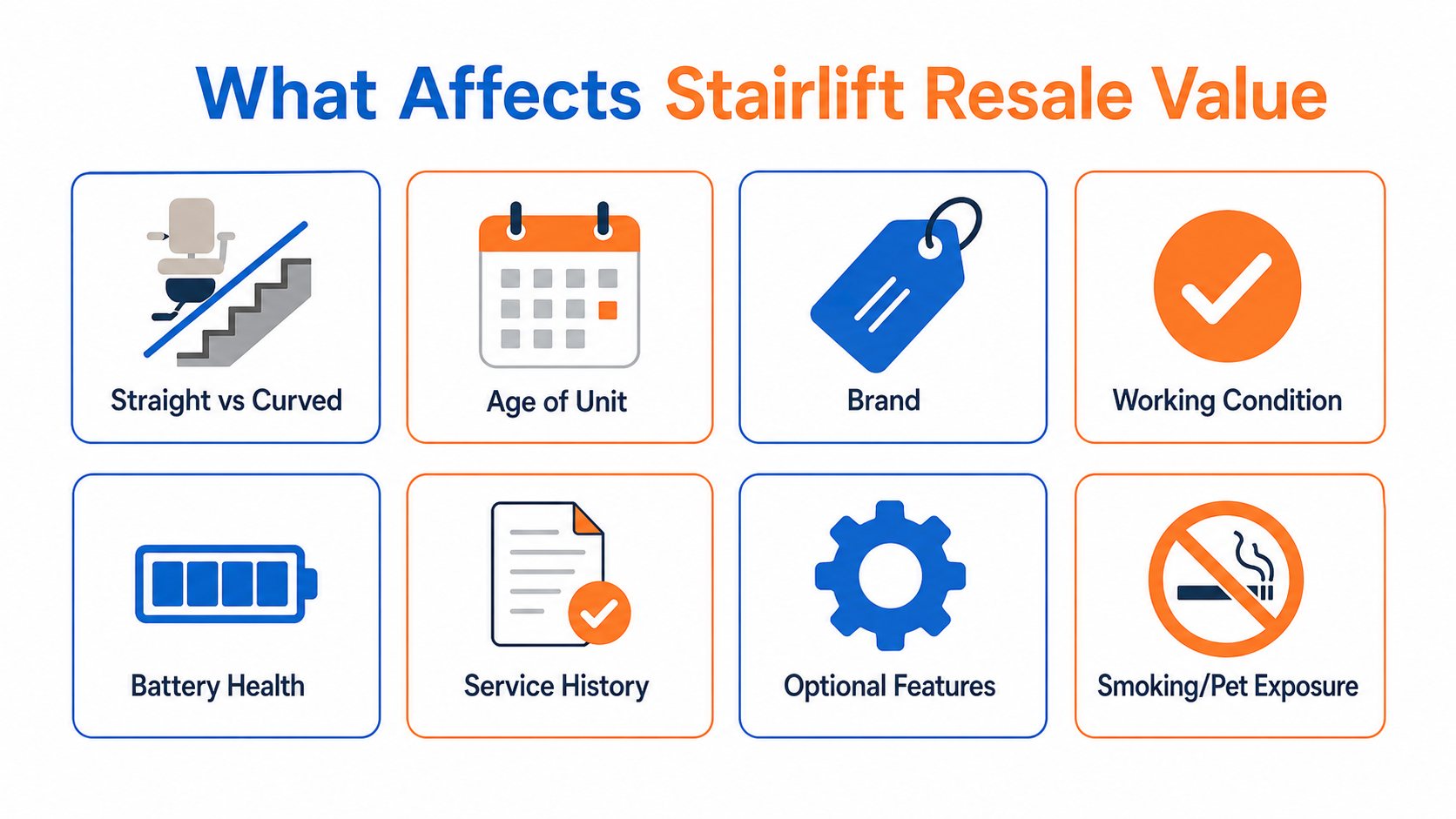
In rough order of impact:
- Straight stairlifts are worth two to four times more than curved ones of the same age, because the rail is reusable.
- Most buy-backs cap at 7 to 10 years of age. After that, value drops to scrap territory.
- Acorn, Stannah, Handicare, Brooks, and Minivator have the strongest second-hand demand, because parts and service availability are best for those brands.
- A unit that runs end-to-end without issues is worth two to three times more than one with a fault, even a small one.
- Batteries are typically replaced every 3 to 5 years, so a unit with recent batteries is more attractive.
- Documented annual servicing adds confidence, and confidence adds price.
- Optional features such as a powered swivel, hinged rail, heavy-duty seat or larger weight capacity all add small premiums.
- Some buyers exclude units from heavy-smoking or pet-heavy homes for hygiene reasons.
Who Buys Second-Hand Stairlifts in the UK?
If you are wondering “who buys second-hand stairlifts near me?”, the answer is three types of buyer, each offering a different trade-off between speed, price, and effort.
- Specialist stairlift buy-back companies are the fastest route. Companies like We Buy Any Stairlift, Sell My Stairlift, Cash4Stairlifts, and regional independents exist solely to buy, remove, and resell or recycle used stairlifts. They typically offer £100 to £400, include free removal, and pay by bank transfer within days.
- Stairlift dealers and installers are another route. Many independent stairlift companies buy used straight stairlifts to recondition and resell. Your original installer is always worth asking first because they already have the service history for your unit. Some dealers pay slightly more than buy-back specialists because they save on sourcing costs.
- Private buyers shop on Facebook Marketplace, Gumtree, or eBay. You can sometimes get £50 to £200 more than a trade buyer, but you handle the listing, questions, and arrangement of professional removal. Most sellers find the extra hassle outweighs the small price uplift.
Curved stairlifts are harder to sell because the custom rail rarely fits another staircase. Most buyers of curved units are interested in the carriage and motor for parts, not the complete unit. If you have a curved stairlift, the realistic options are a buy-back company (for parts value plus free removal) or paid professional stairlift removal.
Selling a Stairlift Near You: Does Location Actually Matter?
"Who buys used stairlifts near me" is one of the most common ways people search for this, and the honest answer is that proximity matters far less than most sellers expect.
Most buy-back companies collect nationwide
The specialist buy-back firms operate across the UK rather than from a single depot, and they route collections to whichever engineer is working in your area that week. A buyer being two hundred miles away rarely changes the offer, because the value is in the carriage and motor rather than the mileage.
What your location does change
Two things, mainly. The first is timing: collections in and around the larger cities are often arranged within a few days, while rural areas, the far south west, mid Wales and the Scottish Highlands more commonly run to two or three weeks. The second is the size of your local pool of alternatives. If you live near several independent stairlift dealers you have more chance of a competing offer, because a dealer who can collect on the way back from another job saves on sourcing.
The one local call worth making
Ask the company that originally installed the stairlift. They already hold the service history, they know the model, and they are often the only party who can price it accurately without a site visit. Compare that against one nationwide buy-back offer and you have a realistic range in a couple of days.
What distance should never do is push you into a doorstep deal. If someone offers cash on collection with no written offer beforehand, the distance they travelled is not a reason to accept less than you were quoted. See how to avoid resale scams below.
Resale by Brand (UK 2026)
Brand affects how much your stairlift sells for and which buyers will take it. Typical 2026 buy-back ranges for working units up to 7 years old:
| Brand | Straight (typical) | Curved (typical) | Notes |
|---|---|---|---|
| Acorn | £200 to £400 | £150 to £300 | Strongest second-hand demand, own resale scheme |
| Stannah | £250 to £500 | £200 to £400 | Holds value best, longest service network |
| Handicare | £200 to £400 | £150 to £300 | Strong curved range, Freecurve carriage in demand |
| Brooks | £150 to £350 | £100 to £250 | Mid-market, swivel seat units sell well |
| Minivator / Bison | £150 to £300 | £100 to £200 | Narrow stair models popular for restricted spaces |
| Companion / Meditek / Other UK | £100 to £250 | £75 to £200 | Smaller buyer pool, parts availability varies |
For a deeper brand comparison, see our stairlift companies and reviews.
Stairlift Buy-Back Schemes: Who Runs One and What They Pay
"Buy-back" gets used loosely in this market, and it covers four quite different arrangements. Knowing which one you are being offered is the difference between a few hundred pounds and nothing at all.
| Arrangement | Who qualifies | What you typically get | Speed |
|---|---|---|---|
| Manufacturer or retailer scheme | Usually only the original customer of that company | Predictable, but rarely the highest figure available | Slower, tied to their own process |
| Independent buy-back company | Anyone, subject to the brand, age and condition | £100 to £400 for a working straight lift under about seven years old | Written offer in around 48 hours, collection in one to three weeks |
| Trade-in against a new lift | People buying a replacement from the same supplier | Taken off the price of the new lift rather than paid to you | Handled with the new installation |
| Free removal, no payment | Older, faulty or less common lifts | No cash, but no removal fee either, which is worth £80 to £300 | Usually the quickest of the four |
Which manufacturers run their own scheme?
It's less common than the search volume suggests. Acorn helps original customers sell privately through its own resale process. Ableworld offers a guaranteed buy-back on stairlifts that were bought from them.
Most other national brands don't run a formal consumer buy-back, which is why the independent firms exist. So if you search for a specific brand buy-back and find nothing official, that's usually the reason. The brand table above shows what independent buyers pay for that make instead.
Is a buy-back the same thing as free removal?
No, and this is where people get caught out. Some companies advertise a buy-back, then turn up with a nil offer and present the free collection itself as the benefit.
Free removal does have real value, between £80 and £300 depending on the type. But it isn't a sale. Get the figure in writing before anyone books a collection date. If a company refuses to put a number in an email, take that as your answer.
VAT, Tax, and Financial Considerations
Selling a used stairlift is a private sale in most cases, and there is no VAT to pay or income tax to declare for individuals selling their own domestic equipment. A few financial points are worth knowing.
VAT exemption on the original purchase. If you bought the stairlift VAT-free under the VAT exemption for disabled people, selling the unit privately does not create any VAT liability. The exemption applied to the original purchase, not to subsequent resale.
Disabled Facilities Grant (DFG) conditions. If a council DFG paid for the stairlift, check for conditions. Some local authorities say equipment funded by the grant should be offered back to the council when it's no longer needed. Some say a portion of the grant may be recoverable from the estate if the property is sold within 10 years.
In practice, enforcement varies widely by council. Check your original grant letter, or contact the council's housing grants team to clarify your position. Our stairlift grants guide has more detail.
Insurance. If the stairlift was covered under your home insurance, notify your insurer once it has been removed. This may slightly reduce your premium, particularly if the stairlift was listed as a specified item.
Capital gains. Stairlifts are personal possessions, not investment assets. Private sales of personal possessions below £6,000 are exempt from capital gains tax, so this is unlikely to apply.
Special Cases: Bereavement, Moving House, and Broken Units
After a bereavement
Clearing a relative’s home works the same way, with extra paperwork. Most buy-back companies accept proof of ownership through probate documents or a letter from the executor.
Allow extra time. Grant of probate typically takes 6 to 12 weeks, and removal companies will usually want it in writing before they pay out. Our selling a stairlift after bereavement guide covers the process in detail.
Moving house
Moving house? Whether to sell the stairlift or leave it in place comes down to one thing: will the next buyer pay extra for it? That’s rare, unless the home is being sold to a household with mobility needs.
In most cases, selling before completion through a buy-back scheme is quicker than negotiating a stairlift premium with the buyer. See selling a stairlift when moving house.
Broken or non-working stairlifts
A non-working stairlift is rarely worth more than £75 in the UK in 2026. Three sensible routes: (1) free removal by a buy-back company that recovers parts, (2) paid removal by a stairlift specialist, typically £80 to £300, or (3) scrap recycling through a licensed UK waste carrier. See scrap or dispose of a stairlift.
Stairlift Disposal and Recycling
If your stairlift is too old, too damaged, or simply not worth selling, disposal is the practical next step. There are three ways to dispose of an unwanted stairlift in the UK.
- Several UK buy-back companies will remove a stairlift at no cost to you, even if they pay nothing for the unit itself. They recover the value through parts salvage and metal recycling. This is the easiest disposal route for most people.
- If no buy-back company will take the unit (very old, obscure brand, or non-working), a stairlift removal specialist will dismantle and take it away for £80 to £300. See our stairlift removal cost guide for current prices by brand.
- For units that cannot be removed intact (fire-damaged, structurally compromised), a licensed waste carrier can collect and dispose of the stairlift as waste electrical equipment (WEEE). Check the carrier holds a valid Environment Agency licence before booking.
Never fly-tip a stairlift. Dumping electrical equipment is a criminal offence under the Environmental Protection Act 1990 and carries an unlimited fine. Council bulky waste collections do not normally accept stairlifts because of the electrical components.
If you are unsure whether your stairlift has any resale value at all, use our stairlift valuation tool for a quick estimate before deciding between selling and disposal.
How to Avoid Stairlift Resale Scams
The used stairlift market attracts a small number of operators who undercut the legitimate trade. Five rules that keep you safe:
- Always get the offer in writing before any removal. A verbal “we’ll see when we get there” almost always ends with a lower price on the day.
- Never pay an upfront fee to a buyer. Real buy-back services pay you, not the other way around.
- Refuse cash-only, no-paperwork deals. Bank transfer with a paper trail is the safe norm.
- Verify the company’s UK trading address. A real address, a real phone number, and a verifiable Companies House registration. Three minutes of checking saves a bad outcome.
- If a price seems much higher than the rest of the market, it usually is too good to be true. Bait-and-switch is the classic pattern: high quoted price, then “complications” on removal day, then a much lower offer when the unit is half off the wall.
Our avoiding stairlift resale scams guide covers the warning signs in more detail.
Ready to sell your stairlift? Compare quotes from trusted UK buy-back services, free and with no obligation.
Sell Your Stairlift NowFrequently Asked Questions
How long does the whole process take?
From first request to removal and payment, expect 1 to 3 weeks for a buy-back scheme. Same-week is possible with the larger UK buy-back companies if photos and information are clear up front.
Will the buyer pay for removal?
Most buy-back schemes include free removal as part of the offer. Always confirm this in writing because some companies advertise free removal but quote it as a separate line item later.
Will my walls be left looking new?
No. Removal leaves small fixings holes in the wall and tread holes on a few stairs. The buyer’s engineer should fill the most visible holes, but a fresh paint job is typically your job. This is normal across the industry, not a defect.
Do I need to factory-reset the stairlift?
No. There is no user data on a stairlift. The buyer’s engineer will service and reset it before resale.
Can I sell privately on Facebook Marketplace?
You can. The price ceiling is usually higher than a buy-back scheme, but you handle the buyer questions, removal logistics, and the legal grey zone if the buyer reinstalls the unit unsafely. Most sellers find the £100 to £200 of upside is not worth the friction. If you do go private, photograph the unit thoroughly and put the price as £X plus removal at the buyer’s cost.
What if the original installer does buy-backs?
Always worth asking. The original installer often has the best service records on your unit and will sometimes pay slightly more because they trust the maintenance history. Ableworld is the clearest UK example of guaranteed installer buy-backs.
Are there buy-back caps on age or condition?
Yes. Most independent buy-back services cap at 7 years, some at 10. Below those caps, you are looking at scrap or charity routes. A few companies (Cash4Stairlifts and similar) accept any age for recycling, though the price is typically zero in exchange for free removal.
Who buys second-hand stairlifts in the UK?
Specialist buy-back companies (We Buy Any Stairlift, Sell My Stairlift, Cash4Stairlifts), independent stairlift dealers, and private buyers on Facebook Marketplace or Gumtree. Trade buyers are faster and include free removal. Private buyers sometimes pay more but you handle the logistics.
How do I dispose of an unwanted stairlift?
Three options: free removal by a buy-back company (even if they pay nothing for the unit), paid removal by a stairlift engineer (£80 to £300), or collection by a licensed waste carrier for WEEE recycling. Never fly-tip a stairlift. Council bulky waste collections do not normally accept them.
Can I sell a curved stairlift?
Curved stairlifts are much harder to sell than straight models because the custom rail rarely fits another staircase. Most buyers are interested in the carriage and motor for parts, not the complete unit. Expect £100 to £400 for a working curved unit under 7 years old, compared to £200 to £500 for a comparable straight stairlift.
How much is my stairlift worth?
A working straight stairlift under 4 years old is typically worth £300 to £500 in the UK in 2026. Between 4 and 7 years, expect £150 to £300. Over 7 years, value drops to £75 to £150 or free removal in lieu of payment. Brand, condition, and battery health all affect the price. Use our stairlift valuation tool for a quick estimate.
Will Stannah buy back my stairlift?
Stannah may buy back stairlifts that were originally purchased new, are less than two years old, have been regularly serviced, and are in good working condition. The buy-back amount varies. Contact Stannah directly or sell through an independent buy-back company for comparison.
Will Acorn buy back my stairlift?
No. Acorn’s policy is that they do not buy back stairlifts. If you have an unwanted Acorn stairlift, sell through an independent buy-back company or private sale. Acorn 130 straight models are among the most in-demand on the second-hand market because of strong parts availability.
Is it worth selling a stairlift or just paying for removal?
A working straight model under 7 years old is almost always worth selling. Buy-back companies include free removal and pay £100 to £500.
The picture changes if the unit doesn’t work, is over 10 years old, or is a curved model with no matching buyer. Then the practical outcome is free removal in exchange for the unit, with zero payment. That still beats paying £80 to £300 for separate removal.
How long does it take to sell and remove a stairlift?
From first enquiry to removal and payment, expect 1 to 3 weeks with a buy-back company. Same-week removal is possible with larger UK companies if you provide clear photos and information up front. Private sales take longer, typically 2 to 6 weeks to find a buyer.
Article last updated 2 July 2026 by the Stairlift Guru editorial team. Resale price ranges verified against live UK buy-back offers in Q2 2026. Next scheduled review: October 2026.
Choosing a stairlift: our six guides
Independent UK guides on every stage of the decision and the install.
- Is it time for a stairlift? , The decision before you start. Signs, conversations, and what to try first.
- Types of stairlift , Straight, curved, narrow, outdoor, heavy-duty, standing. Which one fits your home.
- Stairlift prices , What stairlifts actually cost in the UK. By type, with what changes the price.
- Stairlift grants and funding , Disabled Facilities Grant, NHS, charity, finance. Who pays for what.
- Buy, rent, or reconditioned , The three routes compared, with a decision flowchart.
- Living with a stairlift , Install, servicing, repair, batteries, sell, remove. The full lifecycle.
Several UK companies buy used stairlifts. Terms vary widely by company, age of the stairlift, and the brand. The table below lists established UK options with their publicly stated conditions. We have no commercial relationship with any of them and receive no referral payments.
| Service | Type | Key conditions | UK coverage | Link |
|---|---|---|---|---|
| Acorn Resale Scheme | Manufacturer resale scheme | Acorn assists its customers in selling privately. Not a direct buy-back. | UK-wide (Acorn customers) | Visit |
| Ableworld Stairlifts | Retailer buy-back | Guaranteed buy-back for stairlifts originally purchased from Ableworld, any age. | UK-wide | Visit |
| Multicare | Independent buy-back | Buys straight and curved stairlifts up to around 3 years old, commonly Acorn and Handicare. | Nationwide UK | Visit |
| Helping Hand Stairlifts | Independent buy-back | Buys Acorn and Brooks stairlifts, straight or curved, 5 years old or newer, from non-smoking homes. | 60-mile radius of Congleton, Cheshire | Visit |
| We Buy Any Stairlift | Independent buy-back | Cash offers for second-hand stairlifts, free professional removal. | UK-wide | Visit |
| UK Stairlifts | Independent buy-back | Online valuation, assessment based on condition, age, and type, then offer and removal. | UK-wide | Visit |
| Sell Your Stairlift Now | Independent buy-back | Same-day payment, professional removal. | UK-wide | Visit |
| Sell My Stairlift | Independent buy-back | Free quotes, UK stairlift removal and buy-back service. | UK-wide | Visit |
| We Can Buy Your Stairlift | Independent buy-back | Buys unwanted stairlifts subject to age and working condition, free removal. | UK-wide | Visit |
| Cash4Stairlifts | Independent buy-back for recycling or disposal | Buys unwanted, used, and second-hand stairlifts for recycling or disposal. | UK-wide | Visit |
How to use this table: request a written offer from two or three services before agreeing to anything. Confirm in writing the price, removal date, who pays for removal, how the stairs will be left afterwards, and how you will receive payment.
Details above are taken from each company's publicly stated terms at the time of writing. Terms change over time, so always confirm current conditions with the supplier directly. Stairlift Guru is independent and not affiliated with any of the services listed.
Not sure what your stairlift is worth?
Get a free, no-obligation quote from local stairlift specialists. Compare prices and find the best option for your situation.
No personal data shared with third parties. Independent and free to use.
Sell Your Stairlift NowSources
Related data and research
- ›UK Stairlift Price Index Current prices by type, brand and configuration
- ›Cheapest Stairlifts in the UK How to find the best deal on a stairlift