

Stairlift Batteries: Lifespan, Charging and Replacement Cost
How They Work, Lifespan, and Replacement CostsStairlift batteries are a key component of most modern stairlifts. They allow the stairlift to continue operating during power cuts and help ensure smooth, reliable movement along the rail.
This guide explains how stairlift batteries work, how long they typically last, common warning signs of failure, and what to expect when replacement is needed in the UK.
Stairlift batteries are rechargeable batteries that power the stairlift motor and controls, which is why a stairlift keeps working even during a power cut.
In the UK, most stairlifts use sealed lead-acid batteries that charge automatically when the stairlift is parked.
How Stairlift Batteries Work
A stairlift does not run directly off the mains. The motor and controls draw power from rechargeable batteries inside the carriage, and the mains supply exists only to charge them through contact strips or charge points on the rail. That design is deliberate: it means the lift keeps working through a power cut, and it is why battery health decides whether a stairlift is dependable.
When the lift is parked at a charge point, usually at the top and bottom of the rail, charging happens automatically. There is nothing to plug in or press.
What Type of Batteries Do Stairlifts Use?
Nearly all UK stairlifts run on two 12-volt sealed lead-acid batteries working together as a 24-volt pair. Most models use standard sizes in the 2.9Ah to 7Ah range, and the batteries are sealed and maintenance-free, so there is no topping up or venting to think about. Acorn, Stannah, Handicare and Brooks all use variations of this same arrangement, with the exact size varying by model.
How Long Do Stairlift Batteries Last?
Two to five years is the normal range. What moves you within it:
- A lift always returned to its charge point lives longest. Batteries left partially discharged sulphate and fade early.
- Switching the lift off at the wall to save electricity is the classic battery killer. The standby draw costs a few pounds a year; replacement batteries cost far more.
- Both heavy daily use and long idle periods age batteries faster than moderate regular use.
- Cold shortens battery life, which is why outdoor stairlifts get through batteries faster than indoor ones.
How Long Does Charging Take?
From completely flat, a full charge takes roughly 8 to 12 hours. In normal use the question rarely arises, because the lift tops up every time it parks, keeping the batteries near full. The practical rule: after any long power cut, park the lift on a charge point and leave it overnight before judging whether the batteries have a problem.
Stairlift Battery Not Charging? Check These First
Before booking an engineer, three checks solve most charging complaints:
- Check the parking position. The lift only charges on its charge points. If it stopped mid-rail, or someone parked it a few inches short, it is not charging. Move it fully onto the charge point and listen for the beeping to stop.
- Make sure the socket or fused spur that feeds the rail has not been switched off, and that a cleaner or visitor has not unplugged it. This is the single most common cause.
- Clean the charge point contacts. Dust on the rail contact strips can interrupt charging; a dry cloth along the contacts sometimes fixes it.
If the power and parking are both right and the lift still beeps, moves slowly or stops partway, the batteries aren’t holding charge and need replacing. Continuous beeping straight after new batteries go in usually points to a charging fault. The batteries are less likely to be the cause, and it’s an engineer job.
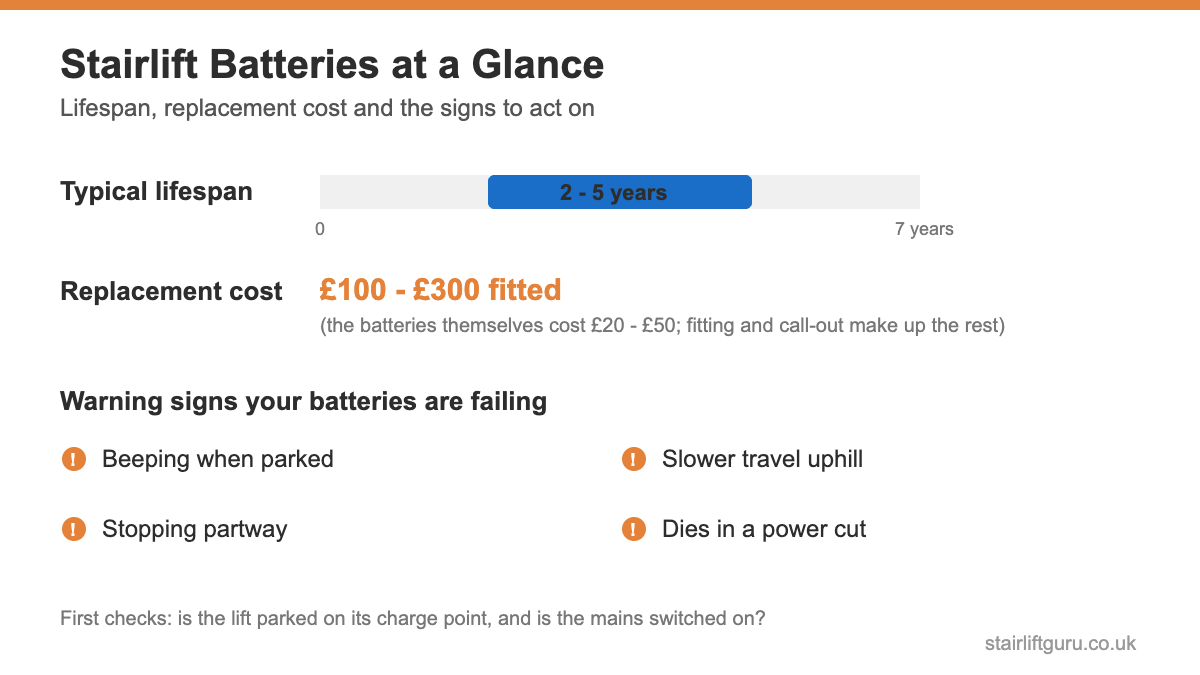
Warning Signs Your Batteries Are Failing
- Beeping or warning tones when parked
- Noticeably slower travel, especially uphill
- Stopping partway up the stairs
- Not working during a power cut, or dying quickly afterwards
A lift showing these signs is running on borrowed time; a mid-stairs stop with someone aboard is the failure you are trying to avoid. More symptoms and what they mean are covered in warning signs your stairlift needs servicing.
Stairlift Battery Replacement Cost (UK)
Having an engineer replace them costs £80 to £300, including parts, labour and call-out. The exact figure depends on the model and how far the engineer travels.
The batteries themselves are cheap, typically £20 to £50 for a standard pair. People are often surprised until they see the labour involved: the carriage has to be opened, the correct type fitted and the charging system checked.
Battery replacement counts as a repair, so it usually isn’t included in a basic annual service. Some service plans include battery checks and discounted replacement. See our stairlift repairs guide for how it fits into ownership costs, and stairlift servicing costs for what a standard service covers.
Can You Replace Stairlift Batteries Yourself?
On some models it’s mechanically within reach of a confident DIYer, and replacement batteries are freely sold. Engineers still do most of them, for three reasons.
Fitting the wrong type causes faults. Opening the carriage the wrong way can disturb safety systems. And DIY work can void a warranty that would otherwise have covered the job.
If the lift is under warranty or a service plan, use the engineer. If it’s an older lift you own outright, weigh the £100 to £300 against the risk.
Making Batteries Last: Four Habits
- Always park the lift on a charge point after use
- Never switch off the mains supply to the lift, even on holiday
- Act on warning beeps the day they start, not the month after
- Book an annual service so charging faults get caught early
Batteries for Outdoor Stairlifts
Outdoor models face temperature swings that indoor lifts never see, and cold weather in particular cuts both capacity and lifespan. Expect to replace outdoor stairlift batteries more often. Keep the weather cover on when the lift is parked. If it turns sluggish in winter, don’t dismiss it as a quirk. It’s an early warning. Our outdoor stairlifts guide covers year-round care.
Frequently Asked Questions
Do stairlifts work during a power cut?
Yes. The lift runs from its batteries, so a healthy set keeps it working through an outage, typically 20 or more round trips.
If you rely on your stairlift day to day, it is worth joining the Priority Services Register as well. This is a free scheme for people of pensionable age, people with a disability or mobility difficulty, and anyone who uses equipment that needs electricity.
Once registered, your electricity network gives you priority updates and support during a power cut, and in longer outages the help can extend to home visits, hot meals or alternative accommodation. One sign-up at thepsr.co.uk covers both your network operator and your energy supplier, or you can call 105 to reach your local network operator and ask to be added.
How often do batteries need replacing?
Every 2 to 5 years[2] depending on use, charging habits and conditions.
How long does charging take?
8 to 12 hours from flat; continuous top-up in normal use means the batteries stay near full.
Why is my stairlift beeping?
Usually low charge: check the lift is parked fully on its charge point and the mains is on. Persistent beeping after both checks means worn batteries or a charging fault.
Are batteries covered by warranty?
Sometimes in the first year or two; batteries are consumables, so many warranties exclude or limit them. Check your terms.
Key Takeaways
- Stairlifts run on two sealed lead-acid batteries charged automatically at the rail’s parking points
- Lifespan is 2 to 5 years; parking habits and an always-on mains supply matter most
- Replacement costs £100 to £300 fitted, and beeping or slowing are the standard warning signs
- Most charging problems are parking position or a switched-off socket, not the batteries
Where to Go Next
For the wider picture of keeping a lift healthy, see stairlift servicing and how to look after a stairlift. If your lift has stopped entirely, stairlift repairs explains what engineers charge and when repair beats replacement. And if a battery quote has you questioning the lift’s future, current stairlift prices put the repair-or-replace decision in context.
We don’t sell or fit stairlifts. Quotes go to UK suppliers.
Quotes are free. We’re only paid if you buy: the supplier we introduced you to pays us a fee. How we are funded
Free, no obligation
Choosing a stairlift: our six guides
Independent UK guides on every stage of the decision and the install.
- Is it time for a stairlift? , The decision before you start. Signs, conversations, and what to try first.
- Types of stairlift , Straight, curved, narrow, outdoor, heavy-duty, standing. Which one fits your home.
- Stairlift prices , What stairlifts actually cost in the UK. By type, with what changes the price.
- Stairlift grants and funding , Disabled Facilities Grant, NHS, charity, finance. Who pays for what.
- Buy, rent, or reconditioned , The three routes compared, with a decision flowchart.
- Living with a stairlift , Install, servicing, repair, batteries, sell, remove. The full lifecycle.
Related Expert Guides
Sources
Related data and research
- ›Warranty & Aftercare Comparison UK brand warranty and service plans compared
- ›Stairlift Service Plan Cost What UK service plans cost a year, company by company, and whether one is worth it
- ›Stairlift Not Working? Symptom by symptom: what to check first, when to call an engineer, repair or replace
- ›Stairlift Fault Codes Acorn, Stannah and Handicare display codes from the makers' own manuals
- ›Acorn Stairlift Troubleshooting Every Acorn display code and the four checks that clear most stopped lifts
- ›Stannah Stairlift Troubleshooting What each Stannah 600 series code means and when to call an engineer
- ›Handicare Stairlift Troubleshooting Handicare and Minivator display codes and common faults