

Stairlift Installation
Installing a stairlift in your home can be a simple task done by a qualified stairlift engineer. Someone on their own should not do it. Stairlift installations can take just a few hours, depending on the type of stairlifts, such as a curved stairlift or a straight stairlift. Most stairlift companies include the cost of installation in the price of the stairlift model.
Stairlift Installation: Key Information
- Fitting takes 2 to 4 hours[1] for a straight stairlift; curved models need 2 to 6 weeks overall because the rail is made to measure
- The rail bolts to the stair treads, not the wall, so no structural work, planning permission or building regs approval is needed
- Installation is normally included in the price of a new stairlift; refitting a second-hand lift costs £300 to £500
How Stairlift Installation Works
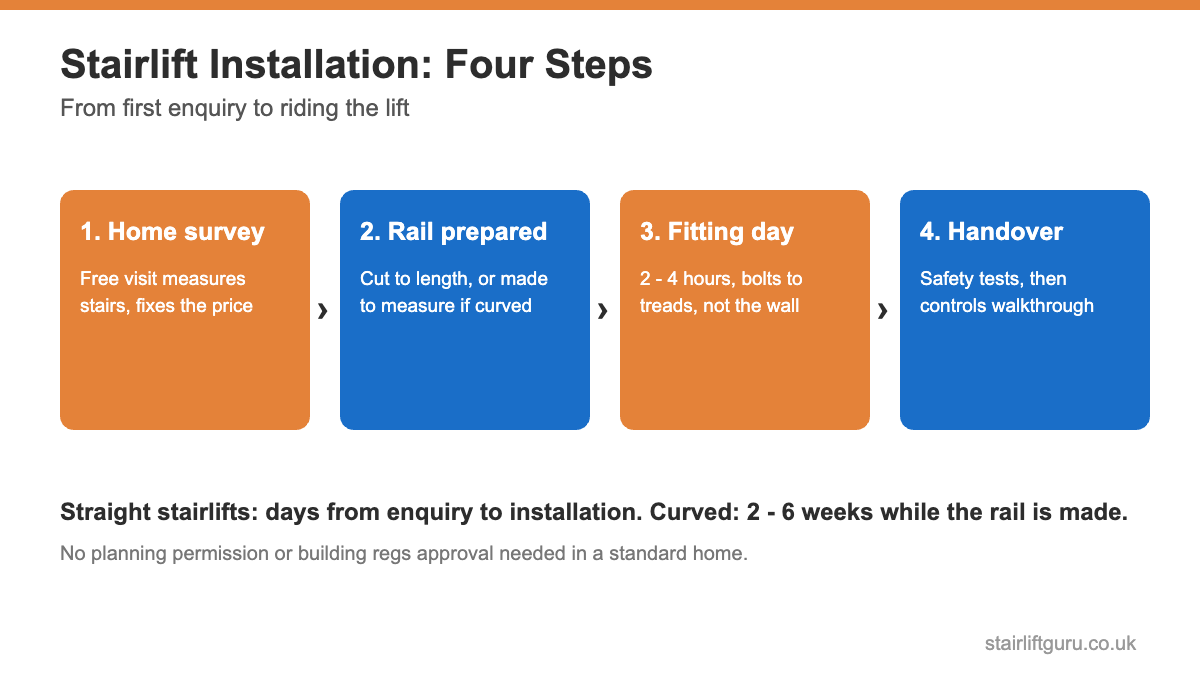
Every installation follows the same four steps. First, a home survey: the engineer measures the staircase, checks the power supply and discusses where the lift should park. Second, the rail is prepared, cut to length for a straight staircase or manufactured to measure for a curved one. Third, installation day: the rail is bolted to the stair treads, the carriage fitted, and the charging points wired to a standard socket. Fourth, handover: the engineer tests the safety systems, then walks you through using the seat, the controls and the remotes.
The often-repeated worry about wall damage has it backwards: a stairlift attaches to the treads of the staircase, never the wall. When the lift is eventually removed, a few filled screw holes in the treads are the only trace, which is covered in our stairlift removal guide.
What a stairlift home survey should include: a checklist
Every stairlift starts with a home survey, and it is free with every major supplier. It is also where most later problems can be prevented. A good survey takes long enough to measure properly and to talk to the person who will use the lift. It ends with a written quote you can take away and compare, not a price that only holds if you sign on the day.
Use this list during the visit. If something on it did not happen, ask for it before you accept a quote.
The staircase
- The full length of the stairs measured, and the number of steps counted
- The width measured at the narrowest point, from the skirting board rather than the wall (slimline models can fit from about 610mm)
- Any turns, half-landings, winders or a bottom step that curves out, noted and photographed
- Radiators, handrails, window sills or doors near the stairs checked for clearance
- The treads checked for condition, since the rail is fixed to them, not to the wall
The top and the bottom
- Where the lift will park at each end, and whether it blocks a doorway or a hallway when parked
- Whether the rail will overhang the bottom step into a walkway, and if so, whether a hinged or folding rail is needed (and what it adds to the price)
- Where the nearest mains socket is for the charging point
- Room at the top landing to get off safely, which is where a powered swivel seat may be recommended
The person who will use it
- A conversation with the user, not only the family, about how they get on and off and what they find hard
- Their weight checked against the model’s limit (heavy-duty models exist for heavier users)
- Whether they can sit, bend their knees and swivel, or whether a standing or perch lift should be considered
- Controls, remotes and seat height talked through, with any dexterity or eyesight needs in mind
- Whether an occupational therapist’s assessment already exists, or should come first if a grant may be involved
What the written quote should show
- The make and model, and whether it is new or reconditioned
- The price with each extra listed separately: powered swivel, hinged rail, extra remotes, outdoor protection
- Whether VAT is included, and a VAT relief declaration form if the user is eligible for zero-rating
- The warranty in writing: length, what it covers, and the engineer call-out time
- What servicing costs after the warranty ends
- The fitting date or lead time (curved rails are made to measure and take longer)
- What happens to the lift and rail if it is no longer needed: removal cost, buy-back or resale
- How long the quote stays valid, with no pressure to sign on the day
Already have a quote? Our stairlift quote checker shows where it sits against typical UK prices and whether the VAT on it is right. The warranty and call-out comparison shows what each company publishes about aftercare.
How Long Does It Take to Install a Stairlift?
| Stage | Straight stairlift | Curved stairlift |
|---|---|---|
| Home survey | Within days of enquiry | Within days of enquiry |
| Rail preparation | Cut to length, often from stock | Made to measure, 2 – 6 weeks |
| Fitting on the day | 2 – 4 hours | Half a day |
| Total from enquiry | A few days to a week | 2 – 6 weeks |
Suppliers can move faster for urgent needs, for example hospital discharge; ask about express installation when you enquire. If the wait matters, a rented stairlift can bridge the gap.
What Does Installation Cost?
For a new stairlift, installation is included in the quoted price: £1,500 to £3,500 installed for straight models and £4,000 to £7,000 for curved models, per our UK Stairlift Price Index. Standalone installation, for example refitting a second-hand lift you bought privately, runs £300 to £500 for straight models. The detail is in stairlift installation costs, and the cost calculator gives an instant bracket for your staircase.
Do You Need Permission?
No planning permission and no building regulations approval are needed for a stairlift in a standard home, because nothing structural changes; the rail bolts to the treads. Two exceptions deserve a call before work starts: listed buildings, where the conservation officer should approve fixings, and communal staircases in flats, where the freeholder or management company has a say. For new-build or renovation projects, Approved Document M of the Building Regulations covers accessible design; allowing a straight run and a socket near the stairs makes any future installation trivial.
Can Any Staircase Take a Stairlift?
Nearly all can. Straight flights take standard rails. Turns, intermediate landings and spirals take custom curved rails, which handle multiple turns without difficulty. Narrow staircases down to roughly 610mm usually accommodate a slimline model with a folding seat; our narrow staircase guide covers the measurements that matter. Outdoor steps take weatherproofed models, covered in outdoor stairlifts. The genuine exceptions, very narrow winders or structurally weak treads, are exactly what the free home survey exists to catch.
Can You Install a Stairlift Yourself?
DIY installation is a false economy and most manufacturers will not warrant a self-installed lift. Rail alignment, charge-point positioning and the safety cut-outs all need setting up correctly for the lift to be safe, and an engineer does the whole job in an afternoon. If you have bought a second-hand lift, budget £300 to £500 for professional refitting, and read our reconditioned stairlifts guide first, since a recon unit from a dealer arrives with installation and a warranty included.
Preparing for Installation Day
- Clear the staircase and the landing areas at both ends
- Make sure a mains socket is available near the stairs; the engineer will advise at survey if not
- Plan for the engineer to need 2 to 4 hours of access
- Have questions ready for the handover: parking positions, the remotes, and what the warning beeps mean
Funding an Installation
The Disabled Facilities Grant can cover some or all of a stairlift where a council occupational-therapist assessment supports it, and most buyers qualify for VAT relief, which takes roughly 17 percent off a VAT-inclusive price; check your figures with the VAT exemption calculator. Charities including Age UK sometimes help where grants fall short.
Need a date quickly? Our guide to how fast a stairlift can be fitted compares next-day and curved-rail lead times published by 18 UK suppliers.
Frequently Asked Questions
How long does it take to install a stairlift?
2 to 4 hours on the day for a straight lift; half a day for curved. Lead time is days for straight, 2 to 6 weeks for curved rails.
Is installation included in the price?
With a new lift, yes. Standalone refitting of a second-hand lift costs £300 to £500.
Does a stairlift damage the stairs or walls?
No wall contact at all; the rail bolts to the treads, leaving only small filled holes on removal.
Do I need building regs or planning permission?
No, except for listed buildings and communal staircases, where a call ahead is wise.
Who installs stairlifts?
Manufacturer engineers (Stannah, Acorn, Handicare) or trained installers at local mobility dealers; compare both routes in our stairlift companies guide.
We do not sell or install stairlifts. Quotes go to UK suppliers.
If you buy a stairlift from a supplier we introduced you to, that supplier pays us a fee. Requesting quotes is free and we are not paid for the request itself. How we are funded
Free, no obligation
Choosing a stairlift: our six guides
Independent UK guides on every stage of the decision and the install.
- Is it time for a stairlift? , The decision before you start. Signs, conversations, and what to try first.
- Types of stairlift , Straight, curved, narrow, outdoor, heavy-duty, standing. Which one fits your home.
- Stairlift prices , What stairlifts actually cost in the UK. By type, with what changes the price.
- Stairlift grants and funding , Disabled Facilities Grant, NHS, charity, finance. Who pays for what.
- Buy, rent, or reconditioned , The three routes compared, with a decision flowchart.
- Living with a stairlift , Install, servicing, repair, batteries, sell, remove. The full lifecycle.
Sources
Related Data & Research
- ›Consumer Satisfaction Survey Ratings and reviews across major UK brands