
Wider guide: see Types of stairlift, the six types in common UK use, with what fits which home.
Quick answers
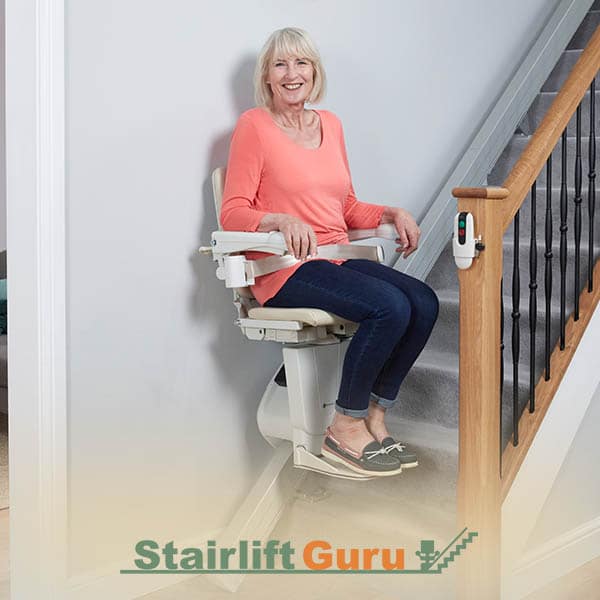
In use: the user sits down, fastens the seat belt and drives the lift with a control on the armrest. It runs on rechargeable batteries, so it keeps working in a power cut.
The parts: a rail fixed to the stairs, a carriage holding the motor and batteries, the seat, the footrest and the controls. Sensors on the footrest and carriage stop the lift if they touch an obstruction.
Before you buy: check the lift suits both the staircase and the user, ask what the warranty and servicing cover, and get the quote in writing.
If you’re thinking about a stairlift, it helps to know how the parts fit together. It makes the models you’re quoted much easier to compare.
Stairlifts look complicated, but the idea is simple. A chair on a motorised carriage runs along a rail fixed to your stairs.
How Do Stairlifts Work Key Points
- A surveyor measures the stairs and checks the user’s needs before anything is fitted.
- The user drives the lift with a control on the armrest. Call controls or remotes at the top and bottom bring it to them.
- It runs on rechargeable batteries, so it keeps working in a power cut.
- The batteries charge whenever the lift is parked at a charging point.
- The seat usually folds up, along with the arms and footrest, when it isn’t in use.
- A seat belt keeps the user in place for the whole journey.
- Before operating the stairlift, ensure the user is safely seated and in the correct position, with the seatbelt fastened, to use the stairlift safely.
- Sensors on the footrest and carriage stop the lift if they touch an obstruction.
- A motor in the carriage drives the chair along the rail.
- Get the right lift and follow the directions that come with it if you want to use it safely.
- Want a figure for your own stairs? Use our quote form for a stairlift price estimate.
We don’t sell or fit stairlifts. Quotes go to UK suppliers.
Quotes are free. We’re only paid if you buy: the supplier we introduced you to pays us a fee. How we are funded
Free, no obligation • UK-based suppliers only
Benefits of Stairlifts
A stairlift lets someone with limited mobility get between floors safely and without help. For most users that’s the whole point: the upstairs of the house is back in reach.
It usually costs much less than fitting a home lift or moving to a single-storey home. It also gives the family peace of mind.
Process Of Installing A Stairlift
A trained engineer fits the stairlift after a survey. The survey checks there’s enough room for the user’s legs and arms on the way up, so the ride is comfortable.
Rails for curved stairlifts are made to measure for your staircase, so they take longer to make and fit than straight stairlifts. A straight lift is usually fitted in 2 to 4 hours. A curved one usually takes a full day.
Once it’s fitted, getting upstairs is as simple as sitting down, fastening the belt and pressing the control.
What Constitutes The Components Of A Stairlift?
A stairlift is a set of parts that each do one job: the rail, the motor and carriage, the seat, the footrest and the controls.
The stairlift motor powers a gear that meshes with a geared strip embedded in the track. This mechanism is how the chair moves smoothly up and down the stairs, for a smooth, controlled ride.
The Following Are The Major Parts Of A Stairlift:
The chair sits on a carriage that runs along the rail, a bit like a train on a track. The rail is fixed to the stair treads, not the wall.
The footrest supports the user’s feet and the lift stops if it touches anything on the stairs. Batteries power the motor and charge at the parking points, so the lift keeps working if the mains power goes off.
Additional Essential Stairlift Functions
The seat usually comes with a seat belt, armrests and a footrest, with options such as a powered swivel or a perch seat. Ask which come as standard on the model you’re quoted and which cost extra.
The footrest folds up when it’s not in use. It also has sensors, so the lift stops straight away if the footrest touches something as the stairlift goes up the stairs.
A motor in the carriage, powered by the batteries, drives the chair. A gearbox slows it to a safe, steady speed.
The main control sits on the armrest. There are usually call controls or remotes at the top and bottom of the stairs too, wired or wireless.
Power and Controls
Stairlifts run on rechargeable batteries, charged from the mains through charging points on the rail. That means they keep working during a power cut. Remote controls let the user or a carer call the lift to their floor.
Safety Features
Every stairlift has a seat belt, and sensors that stop the lift if something is in the way. Many also have a swivel seat, which makes getting on and off at the top much safer. Because they run on batteries, a power cut won’t leave the user stranded.
Stairlift Models
Straight stairlifts fit straight staircases. Curved stairlifts have a rail made to measure for stairs that turn or have landings. standing stairlifts suit people who can’t bend their knees easily.
Some rails run past the top step so the user can get on and off on the landing. The right model depends on the user’s mobility and weight, the space you have and the shape of the stairs.
Home Stairlift Buyer’s Checklist
Now you know how they work, think about who’ll use the lift and who’ll help them. When you’re ready, you can get a Stairlift Quote.
How Do Stair Lifts Work?
Here’s the short version of how a stairlift works:
- A rail is fixed to the stair treads. Straight rails are quicker to fit; curved rails are made to measure.
- Rechargeable batteries power the motor, topped up from the mains at charging points.
- The user sits on the seat (or perches, on a perch model) with the seat belt fastened.
- The user or a carer can run a straightforward hand-held device to work the lift.
- The carriage carries the chair up or down the rail.
- Sensors stop the lift if they meet an obstruction.
- The seat, arms and footrest fold up so others can use the stairs.
Stairlifts give people with mobility problems a safe, practical way to use the stairs and stay independent at home.
Summary Of How Do Stairlifts Work
In short: sit down, fasten the belt and use the armrest control. The carriage drives itself along the rail, and the batteries keep it going in a power cut. If you’re thinking of buying a stairlift soon, our buying guide explains what to check.
Choosing a stairlift: our six guides
Independent UK guides on every stage of the decision and the install.
- Is it time for a stairlift? , The decision before you start. Signs, conversations, and what to try first.
- Types of stairlift , Straight, curved, narrow, outdoor, heavy-duty, standing. Which one fits your home.
- Stairlift prices , What stairlifts actually cost in the UK. By type, with what changes the price.
- Stairlift grants and funding , Disabled Facilities Grant, NHS, charity, finance. Who pays for what.
- Buy, rent, or reconditioned , The three routes compared, with a decision flowchart.
- Living with a stairlift , Install, servicing, repair, batteries, sell, remove. The full lifecycle.
 ChatGPT