

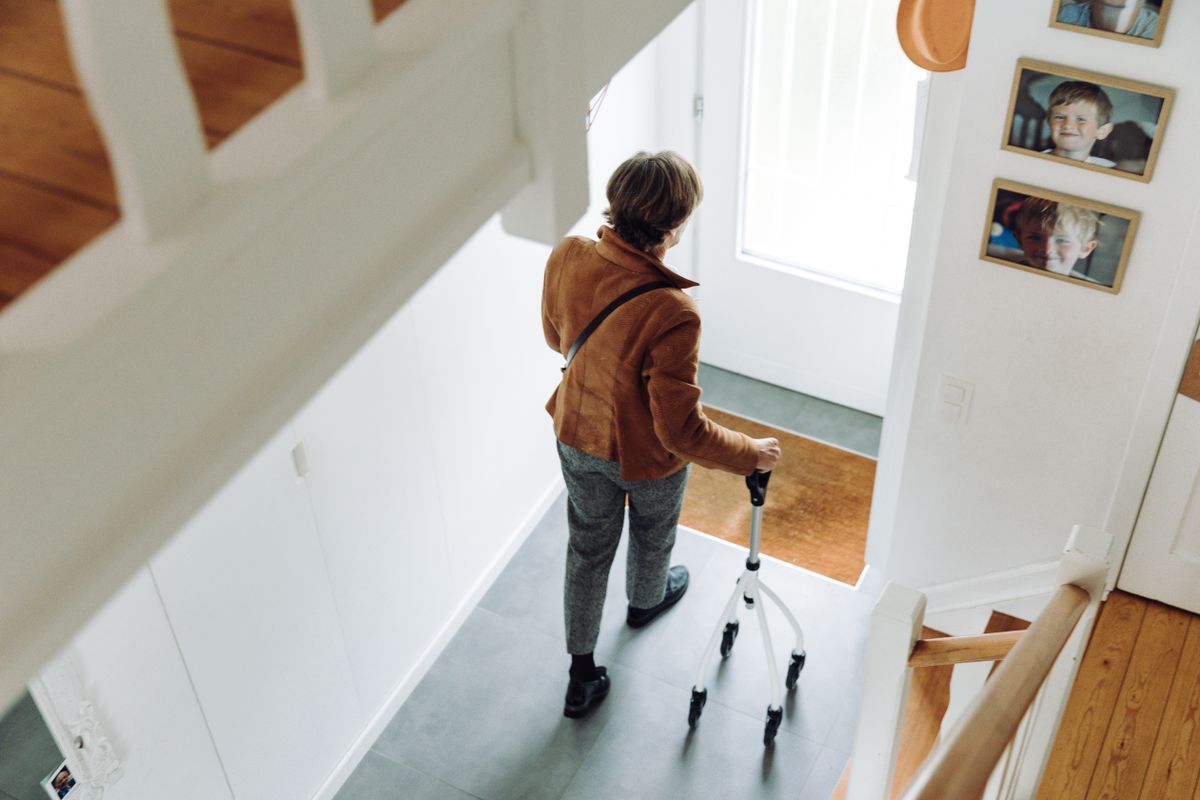
It rarely announces itself. There is no single morning when a parent stops managing the stairs. Instead there are small changes, spread over months, and because you do not see them every day, a visit home can suddenly make them obvious. If something about the way your mum or dad uses the stairs has started to worry you, this guide is for you.
Below are the signs families most often notice, why parents tend to play them down, and what to do next, in an order that respects both their safety and their independence.
The signs worth taking seriously
They pause before the stairs
A hand resting on the newel post, a breath taken at the bottom step. Hesitation is often the first sign that stairs have gone from something they do without thinking to something they plan.
Both hands on the banister
Pulling themselves up with the banister rather than stepping up, or coming down sideways one step at a time, means their legs no longer feel reliable. Some people start coming downstairs seated. It works, until it does not.
They avoid going upstairs
Watch for the quiet workarounds: things accumulating at the bottom of the stairs to go up “later”, a wash instead of a bath, the spare room downstairs becoming where they nap. Avoidance is a safety strategy, and it tells you they already know the stairs are hard.
Life is migrating downstairs
Clothes in the dining room, a duvet on the sofa, a commode “just for nighttime”. When the ground floor slowly becomes the whole home, the stairs have effectively already been lost.
Bruises and near-misses that get played down
“I just caught myself on the door.” Maybe. But unexplained bruises, a stumble mentioned in passing, or a story that changes when you ask twice are worth gentle follow-up. If there has been an actual fall, our after-a-fall checklist covers the first week in detail.
Fear that neither of you names
Sometimes nothing has happened yet. They are simply afraid, and the fear itself changes how they move. We have written separately about what to do when a parent is afraid of the stairs, because fear needs a different response from weakness.
We do not sell or install stairlifts. Quotes go to UK suppliers.
If you buy a stairlift from a supplier we introduced you to, that supplier pays us a fee. Requesting quotes is free and we are not paid for the request itself. How we are funded
Free, no obligation • UK-based suppliers only
Why parents hide it
Most older people are not in denial. They are managing something harder: the fear that admitting difficulty starts a chain of events they cannot control, fuss, interference, and somewhere at the end of it, the words “care home”. So they minimise. Understanding that fear matters, because it means the conversation should offer control, not take it away.
What to do next
Start with a conversation, not a solution
Leading with “you need a stairlift” usually goes badly. Leading with what you have noticed, and asking how the stairs feel to them, goes better. Our guide to talking to a stubborn parent about stair safety has scripts that real families have used.
Ask for an assessment
A GP can refer your parent for an occupational therapy assessment, or you can contact the local council’s adult social care team directly. An occupational therapist will look at how your parent actually manages at home and recommend anything from grab rails to adaptations. Here is what an occupational therapist does and how to get one involved.
Make the quick, cheap changes first
A second banister, brighter lighting on the staircase, secured carpet, nothing stored on the steps. These cost little, help immediately, and are often easier for a parent to accept than bigger changes.
Then look at the bigger options honestly
If the stairs themselves are the problem, the realistic options are living downstairs, a stairlift, or moving somewhere without stairs. Each has costs that families tend to underestimate. We compare them properly in living downstairs vs a stairlift vs moving, and our guide to stairlifts for elderly parents covers what to know if a stairlift looks like the answer, including what stairlifts cost and what grant help exists.
When to act quickly rather than gradually
The gentle, gradual approach is right most of the time. Move faster if there has been a fall on the stairs, if they are visibly exhausted or breathless on the staircase, if they have started sleeping downstairs because they cannot face going up, or if a health condition affecting balance or strength is progressing. In those situations, waiting for the perfect conversation costs more than it saves.
Frequently asked questions
How do I raise this without upsetting my parent?
Name what you saw, ask how it feels, and offer choices rather than conclusions. “I noticed you were holding the rail with both hands, how are the stairs feeling these days?” opens a conversation. “We need to sort out the stairs” closes one.
Do we need a diagnosis before we can get help?
No. An occupational therapy assessment is based on how someone manages day to day, not on having a particular diagnosis. Grant funding, where it applies, follows the assessment.
What does it cost to make the stairs safer?
Rails and lighting improvements are usually modest. A new straight stairlift typically starts around the low two-thousands installed, with full pricing here, and the Disabled Facilities Grant can cover some or all of the cost for those who qualify.
What if they refuse any help at all?
You cannot force it, and trying usually hardens the refusal. Keep the changes small, keep the conversation open, and involve someone they trust, a GP, an old friend, a grandchild. Refusal today is rarely refusal forever.
Trust what you noticed
If you saw enough on one visit to search for this article, you saw something real. Small changes now, a rail, better lighting, one honest conversation, are how families stay ahead of the stairs rather than reacting after a fall. And if a stairlift becomes part of the answer, getting quotes from several companies is the best way to compare options and prices before deciding anything.
Choosing a stairlift: our six guides
Independent UK guides on every stage of the decision and the install.
- Is it time for a stairlift? , The decision before you start. Signs, conversations, and what to try first.
- Types of stairlift , Straight, curved, narrow, outdoor, heavy-duty, standing. Which one fits your home.
- Stairlift prices , What stairlifts actually cost in the UK. By type, with what changes the price.
- Stairlift grants and funding , Disabled Facilities Grant, NHS, charity, finance. Who pays for what.
- Buy, rent, or reconditioned , The three routes compared, with a decision flowchart.
- Living with a stairlift , Install, servicing, repair, batteries, sell, remove. The full lifecycle.
 ChatGPT