
Social care in the UK is being reshaped around a simple idea: support people in their own homes wherever possible, rather than in a hospital bed or a care home. It is a popular principle, but a warning from within the mobility industry this month asks an awkward question that policymakers have largely skipped over. If the future of care is at home, are the nation’s homes actually ready for it?
What the shift to care at home actually means
Over the summer, the direction of social care policy became clearer. Andy Burnham used a high profile speech to launch a major plan for reform, arguing for a principle of home care wherever possible so that people are supported where they usually want to be, rather than in hospital. The Prime Minister followed with a speech on social care at the end of July, and record NHS funding has been announced to give patients a better alternative to a hospital admission.
The logic is sound. Most older people say they want to stay in their own home as they age, and keeping people out of hospital eases pressure on the NHS. But this vision quietly assumes that the homes people live in can support care, recovery and daily life when mobility becomes harder. For a large share of the housing stock, that assumption does not hold.
We do not sell or install stairlifts. Quotes go to UK suppliers.
If you buy a stairlift from a supplier we introduced you to, that supplier pays us a fee. Requesting quotes is free and we are not paid for the request itself. How we are funded
Free, no obligation • UK-based suppliers only
The warning: policy focuses on care, not the homes it happens in
Neil McKenzie, Managing Director at Halton Stairlifts, warned this month that many of the UK’s homes are simply not prepared for people to grow old in them. His point was that conversations about social care tend to concentrate on the care itself, the staff, the funding and the visits, while overlooking the physical spaces where that care will be delivered. A support package looks very different in a home where someone can no longer manage the stairs.
The scale of demand is not in doubt. According to the House of Commons Library, ONS projections show the number of people aged 65 and over could rise by more than 9 million over 50 years, from 12.7 million in 2022 to 22.1 million by 2072. The number of over-65 households in England is projected to grow by more than 3 million between 2022 and 2047. Public interest is rising too, with reported search interest in elderly home care jumping sharply in a single day last month. As more families confront these questions at once, the gap between the ambition of care at home and the reality of ordinary houses becomes harder to ignore.
We do not sell or install stairlifts. Quotes go to UK suppliers.
If you buy a stairlift from a supplier we introduced you to, that supplier pays us a fee. Requesting quotes is free and we are not paid for the request itself. How we are funded
Why the staircase is often the first barrier
Most British homes were built across two storeys, which means that the bedroom and often the only bathroom sit upstairs. When climbing the stairs becomes difficult or unsafe, a person can find themselves effectively confined to one floor, or moving into a hospital or care setting far sooner than their overall health would suggest. A staircase is frequently the single feature that decides whether someone can continue to live and be cared for at home.
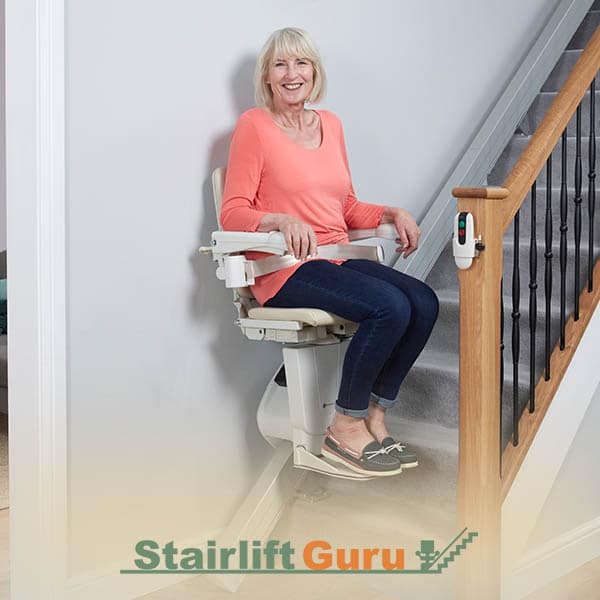
This is where relatively modest adaptations do a great deal of work. Grab rails, better lighting, a downstairs toilet, a level access shower and a stairlift can each remove a specific barrier. A stairlift in particular restores access to a whole floor of the house, which can be the difference between a workable care plan at home and a move elsewhere. The challenge is that awareness, funding and installation all have to line up, and often at short notice after a fall or a hospital stay.
What this means for families, and what you can do
The practical lesson is to think about the home early, before a crisis forces a rushed decision. If a relative is starting to struggle with the stairs, it is worth looking at adaptations while there is time to plan, compare options and arrange funding calmly.
Financial help exists and has grown. The government has confirmed a Disabled Facilities Grant budget of around £723 million for 2026-27, and this grant can contribute towards adaptations including stairlifts for eligible households, subject to a means test and a local assessment. The maximum grant remains £30,000 in England, £36,000 in Wales and £35,000 in Northern Ireland. Because council waiting times for assessments and installations can run to several months, many families pursue a council application and explore a private installation in parallel so they are not left waiting through the winter.
It is also worth understanding the range of choices before committing. Costs vary widely depending on whether a stairlift is straight or curved, new or reconditioned, and whether it is bought or rented. Our guide to stairlift prices sets out typical UK price ranges, based on published UK prices, while our overview of stairlift grants explains how the Disabled Facilities Grant and other funding routes work in practice. If you would rather compare suppliers directly, our list of stairlift companies is a useful starting point.
A home ready for the future
The move towards care at home is likely to define social care for years to come, and for most families it is a welcome one. But the warning from the mobility sector is a fair one. A policy built on ageing at home only works if the homes themselves can keep up. Getting the house ready, with the stairs at the top of the list, is one of the most useful things a household can do to make ageing in place a realistic and safe choice rather than a hopeful one.
Stairlift Guru is independent and not affiliated with any stairlift manufacturer.
Choosing a stairlift: our six guides
Independent UK guides on every stage of the decision and the install.
- Is it time for a stairlift? , The decision before you start. Signs, conversations, and what to try first.
- Types of stairlift , Straight, curved, narrow, outdoor, heavy-duty, standing. Which one fits your home.
- Stairlift prices , What stairlifts actually cost in the UK. By type, with what changes the price.
- Stairlift grants and funding , Disabled Facilities Grant, NHS, charity, finance. Who pays for what.
- Buy, rent, or reconditioned , The three routes compared, with a decision flowchart.
- Living with a stairlift , Install, servicing, repair, batteries, sell, remove. The full lifecycle.
 ChatGPT