
The government has quietly rewritten one of the most important rulebooks in English housing, and for the first time it puts accessibility at its heart. An update to the National Planning Policy Framework now requires that at least 40 per cent of homes on major new developments are built to an accessible and adaptable standard. It is a change campaigners have chased for more than a decade, and it matters for anyone thinking about how a home will work as they grow older.
Here is what the new rules say, why they have prompted a mixed response, and what they mean in practice if you or a relative already need a stairlift or other home adaptation today.
What the new planning rules actually say
The National Planning Policy Framework, or NPPF, is the document that guides councils in England on land use, housing targets and planning decisions. In its August 2026 update, the government added a requirement that local plans ensure no less than 40 per cent of homes on major developments are delivered to the M4(2) “accessible and adaptable” standard, subject to some plan-based exemptions. An exemption that previously applied to qualifying self-build and custom-build homes was also removed for planning applications made on or after 6 August 2026.
M4(2) is a building regulations standard, and it is worth understanding because it is designed with future needs in mind. An M4(2) home has step-free access to the entrance and to the rooms and facilities on the entrance level, wider doorways and hallways, and a toilet at entrance level. Just as importantly, it is built to be adapted later. That includes staircases designed so a stairlift can be fitted if it is ever needed, and bathrooms laid out so grab rails can be added without major work. In other words, the standard does not force every feature to be installed on day one. It makes the home ready for change.
The government framed the move as a way to “ensure plans adequately provide for the accessibility needs of an ageing population and the needs of disabled people.” It sits alongside a wider set of NPPF reforms aimed at speeding up housebuilding, including faster approvals for homes near well-connected train stations.
We do not sell or install stairlifts. Quotes go to UK suppliers.
If you buy a stairlift from a supplier we introduced you to, that supplier pays us a fee. Requesting quotes is free and we are not paid for the request itself. How we are funded
Free, no obligation • UK-based suppliers only
Why this matters for an ageing population
The scale of the need is hard to overstate. According to the Centre for Ageing Better, fewer than one in eight homes in England, around 13 per cent, have the four basic features that make them broadly accessible to someone with a mobility need. As the population ages, demand for homes that people can stay in safely is rising far faster than supply.
Building homes that are ready to adapt is cheaper and less disruptive than retrofitting them later. A staircase built to take a stairlift, or a bathroom designed for grab rails, removes obstacles before they become a crisis after a fall or a hospital stay. That is the logic behind the reform, and it is why housing and ageing charities have campaigned for it for years.
We do not sell or install stairlifts. Quotes go to UK suppliers.
If you buy a stairlift from a supplier we introduced you to, that supplier pays us a fee. Requesting quotes is free and we are not paid for the request itself. How we are funded
The response has been welcoming but far from uncritical. The Centre for Ageing Better called the change progress while describing it as a missed opportunity to go further. Its chief executive, Dr Carole Easton OBE, said the 40 per cent minimum “will go some way to tackling the problem” but expressed disappointment that the policy did not require all new homes to meet the standard. Habinteg Housing Association struck a similar note. Its chief executive, Martin Warhurst, argued that the 40 per cent figure “must be a minimum threshold, not a target,” and warned that M4(2) is not a substitute for fully wheelchair-accessible M4(3) homes, which many disabled people need. Both organisations are calling for stronger monitoring so that accessible homes are actually delivered in the numbers and places communities require.
What it means if you need a stairlift now
Here is the honest catch. The new rules apply to future homes on major developments. They do very little for the roughly 96 per cent of older people who live in ordinary existing housing, much of which was never designed with a change in mobility in mind. If you are struggling with the stairs today, a planning reform aimed at new-build sites will not put a stairlift in your hallway.
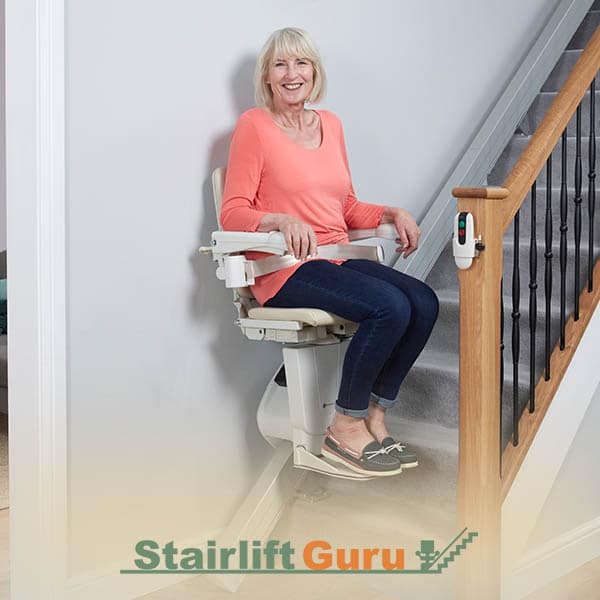
For that, adaptation remains the practical route, and the good news is that the options are well established. A stairlift is one of the most common and least disruptive ways to make a two-storey home workable again, and it can usually be fitted to a straight staircase in a matter of hours. Typical UK prices on our price index put straight stairlifts in a lower range and curved models, which are made to measure for the shape of your stairs, at a higher one. You can read more about what affects the cost on our stairlift prices guide.
Getting help with adaptations today
If cost is a concern, you may not have to pay for everything yourself. The Disabled Facilities Grant is the main route to public funding for home adaptations in England, worth up to £30,000, with equivalents of up to £36,000 in Wales and £35,000 in Northern Ireland. It is administered by your local council and, for a stairlift, normally follows an assessment by an occupational therapist who confirms that the adaptation is necessary and appropriate. Around 60,000 people receive adaptations through the grant each year. Our stairlift grants guide explains who qualifies and how to apply.
Waiting times for the council route can be long in some areas, so it is often worth starting an assessment as early as possible and, if you can, exploring a private installation in parallel. If you decide to go down the private route, it helps to get more than one quote and to check that any installer is reputable and gives a clear guarantee. You can compare providers on our stairlift companies page.
The bigger picture
The NPPF change is a genuine milestone. For the first time, national planning policy accepts that homes should be built ready for the people who will grow older in them, and a staircase designed to take a stairlift is now part of that vision rather than an afterthought. Whether the policy delivers will depend on how councils apply it and whether the 40 per cent floor becomes a ceiling, as campaigners fear.
For today’s households, though, the message is simpler. Do not wait for the housing stock to catch up. If the stairs are becoming a daily worry, a stairlift or another adaptation can restore the run of your own home now, and there is funding and independent advice available to help you plan it well.
Choosing a stairlift: our six guides
Independent UK guides on every stage of the decision and the install.
- Is it time for a stairlift? , The decision before you start. Signs, conversations, and what to try first.
- Types of stairlift , Straight, curved, narrow, outdoor, heavy-duty, standing. Which one fits your home.
- Stairlift prices , What stairlifts actually cost in the UK. By type, with what changes the price.
- Stairlift grants and funding , Disabled Facilities Grant, NHS, charity, finance. Who pays for what.
- Buy, rent, or reconditioned , The three routes compared, with a decision flowchart.
- Living with a stairlift , Install, servicing, repair, batteries, sell, remove. The full lifecycle.
 ChatGPT