

Official projections point to a clear change in how the country will live over the coming decade. Far more of us will grow older in a home of our own, and a fast-rising number will do so alone. For families, that turns a quiet question into a pressing one. If there is no one else in the house, can the person living there still manage the stairs safely, and what is the plan if the day comes when they cannot?
What the latest projections show
The most recent household projections for England, published by the Office for National Statistics, expect the number of households to rise by 10.3 per cent over the decade to the early 2030s, from 23.5 million to 25.9 million. The striking detail is not the headline total but who is driving it. Households headed by someone aged 85 and over are projected to grow by 42.3 per cent, adding around 452,000 homes, and nearly two thirds of those are expected to be people living on their own.
One-person households are the fastest-growing household type of all, up by almost a fifth over the same period, while households headed by someone aged 65 and over rise by more than a fifth. Looking further ahead, the ONS expects the total number of households to reach 28.9 million by the mid-2040s. James Robards, the ONS head of population and household projections, put it plainly: the majority of this growth is likely to be in older age groups, with an increasing number of people living alone.
These are projections based on past trends rather than firm forecasts, and local factors can change the picture in any given area. The direction of travel, though, is not in much doubt, and it has a very practical side for anyone who owns or helps to look after a home with stairs.
We don’t sell or fit stairlifts. Quotes go to UK suppliers.
Quotes are free. We’re only paid if you buy: the supplier we introduced you to pays us a fee. How we are funded
Free, no obligation • UK-based suppliers only
Why living alone changes the maths on home safety
Living alone in later life brings real independence, and survey after survey finds that most people want to stay in their own homes for as long as they possibly can. It also quietly removes a safety net. In a shared household, a partner or relative notices when the stairs start to become a struggle, offers an arm on a bad day, and is there if something goes wrong. On your own, none of that is guaranteed, and the gap between managing and not managing can be a single awkward step.
The staircase is often where difficulty shows up first. It is the one part of the home that cannot be made easier simply by taking things slowly, and for many older people it becomes the barrier that shrinks their living space to a single floor. Falls are the leading cause of accidental death in the UK, and stairs are among the most common places they happen, according to the Royal Society for the Prevention of Accidents. For someone who lives alone, the worry is not only the fall itself but the time that can pass before anyone realises. Planning ahead is how families take that risk off the table before a crisis makes the decision for them.
We don’t sell or fit stairlifts. Quotes go to UK suppliers.
Quotes are free. We’re only paid if you buy: the supplier we introduced you to pays us a fee. How we are funded
The practical options, from small changes to a stairlift
Making a home work for later life does not have to mean major building work, and the sensible approach is to match the change to the need. At the simpler end, a second handrail so there is support on both sides of the stairs, brighter lighting on the landing, and removing trip hazards such as loose runners can all make a real difference for very little money. Grab rails by the bath and the toilet, lever taps and a level-access shower in place of a bath are common next steps for keeping the upstairs and downstairs of a home usable.
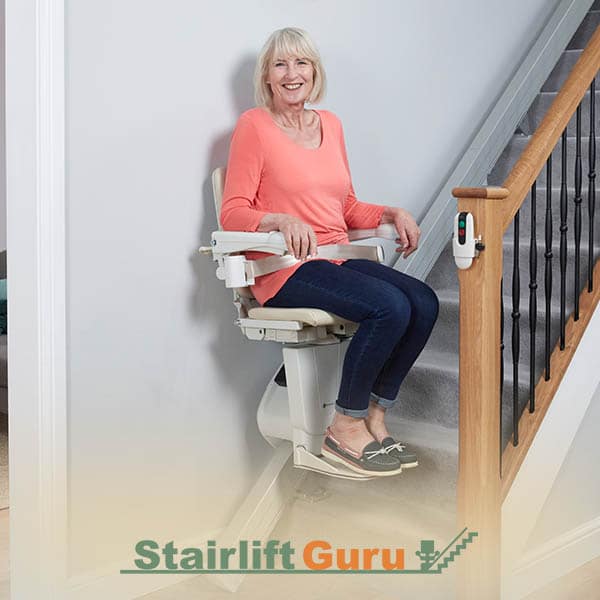
Where the staircase itself has become the problem, a stairlift is one of the most widely used solutions, carrying someone safely between floors and keeping the whole home in use rather than surrendering a bedroom or a bathroom. Typical UK prices reported by industry sources start from around £2,000 for a straight stairlift, with curved models costing more because each rail is built to the shape of the stairs. For a smaller number of homes, a through-floor lift is an alternative. The right choice depends on the staircase, the person and the budget, which is why an assessment is worth more than a quick decision made under pressure.
Planning ahead, and who can help
The value of projections like these is that they turn a national trend into a personal prompt. If you can already see that the stairs are becoming harder for an older relative, or you are weighing up your own home for the years ahead, the time to plan is before a fall or a hospital stay forces the issue. Starting early also tends to open up more routes to help.
In England, a stairlift is one of the adaptations that can be funded through a Disabled Facilities Grant, worth up to £30,000, with different limits in Wales and Northern Ireland and a separate system in Scotland. An occupational therapist assessment, usually arranged through the local council, is the normal starting point, and it can flag smaller changes that help straight away as well as the larger ones. Because assessments and installations can take time in many areas, it is worth beginning the conversation sooner rather than later. If you are funding the work yourself, it helps to understand typical stairlift prices and the difference between buying and renting before you commit to anything.
More people growing older at home, and more of them living alone, is not something to be feared so much as a future to be planned for. A home that already suits the person living in it, with a safe way to get up and down the stairs, is one of the most practical ways to protect independence over the long term. Whether that means a handrail this winter or a stairlift next year, the households that think ahead are the ones least likely to be caught out when the stairs finally become the deciding factor.
 ChatGPT