

When I’m A Celebrity… Get Me Out Of Here! returned to screens on 16 November, producers had quietly made a change that matters far beyond the jungle. For the first time, the camp was adapted for a wheelchair-using contestant, Paralympian and broadcaster Ade Adepitan. It is a timely reminder that home adaptations are not a niche concern, and that the changes many UK households rely on every day deserve the same careful planning that goes into a prime-time television set.
A national spotlight on accessible living
According to reports, ITV spent months preparing the site so that a wheelchair user could take part fully. The changes described in the coverage include widened pathways, additional handrails, all-terrain wheelchairs and, in a detail that surprised many viewers, an outdoor stairlift leading to the camp shower. Industry commentators have put the cost of these one-off, television-scale adaptations in the tens to low hundreds of thousands of pounds, although ITV has not confirmed any figure.
Ade Adepitan, who has spoken publicly about using a wheelchair since childhood, is the first wheelchair user to live in the main camp. Whatever viewers make of the series, the production has put a practical question in front of millions of people: what does it really take to make an everyday space usable for someone with limited mobility, and who helps ordinary families pay for it?
We don’t sell or fit stairlifts. Quotes go to UK suppliers.
Quotes are free. We’re only paid if you buy: the supplier we introduced you to pays us a fee. How we are funded
Free, no obligation • UK-based suppliers only
What accessibility changes cost in an ordinary home
A jungle set is an extreme, temporary example. In a typical UK home the work is far more modest, and far more affordable. The adaptations people ask about most often are grab rails, outdoor and indoor ramps, level-access or walk-in showers, wider doorways and stairlifts. Each of these tackles a specific barrier, and most can be fitted in a day or two with little disruption.
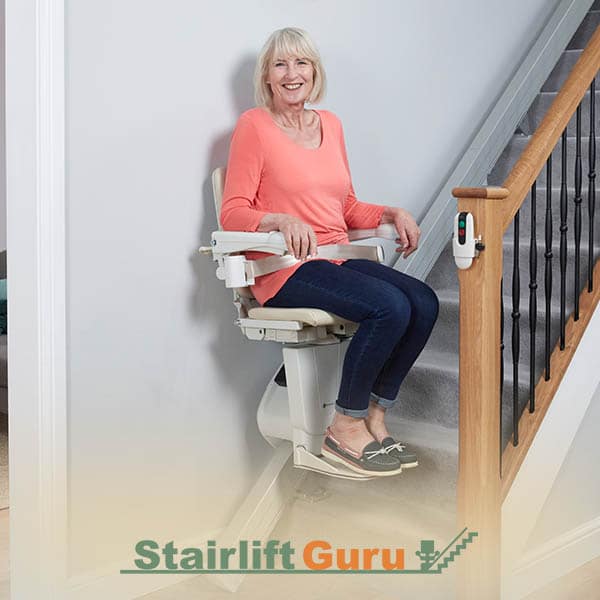
Costs vary with the property, the layout and the complexity of the job. Based on typical UK prices reported by industry sources, a straight stairlift generally starts at a few thousand pounds, while a curved stairlift costs more because the rail is made to measure for your staircase. Grab rails and small fittings are far cheaper, and larger projects such as a through-floor lift or a bathroom conversion sit at the higher end. For many people living in a two-storey home, a stairlift is one of the more cost-effective ways to keep using the whole house rather than moving or converting a downstairs room.
We don’t sell or fit stairlifts. Quotes go to UK suppliers.
Quotes are free. We’re only paid if you buy: the supplier we introduced you to pays us a fee. How we are funded
Who benefits from home adaptations
The people helped by home adaptations are not only wheelchair users. They include older homeowners who find the stairs increasingly difficult, disabled people of any age, and the family members and carers who support them. The common thread is independence: a well-chosen adaptation can reduce the risk of a fall on the stairs, make daily routines safer and allow someone to stay in a home they love rather than move prematurely into residential care.
Many households only start thinking about adaptations after a fall, a hospital stay or the gradual progression of a long-term condition. Acting earlier, before a crisis, usually means more choice, less stress and more time to plan the work properly around the household’s needs.
With the UK population getting older, demand for this kind of practical support is growing steadily. That makes it all the more important for families to understand their options early, rather than feeling forced into a rushed decision when circumstances change suddenly.
The help available to UK families
Financial support exists, and it is more generous than many people realise. In England, the Disabled Facilities Grant is worth up to £30,000 and is administered by local councils. It is means-tested for adults but not for children, and it covers essential adaptations, including stairlifts and ramps, usually following an assessment by an occupational therapist. Wales, Scotland and Northern Ireland each run their own separate schemes, with different rules and limits, so the first step depends on where you live.
Beyond the main grant, some councils offer smaller discretionary grants or interest-free loans, and national and local charities can sometimes help with equipment or costs. The simplest place to begin is your local council’s adult social care team, which can arrange a home assessment and explain what you may be entitled to. An occupational therapist can also recommend exactly which adaptations would make the biggest difference in your home.
It is worth remembering that you do not have to navigate this alone, and that an assessment does not commit you to anything. Taking that first step simply gives you a clearer picture of what is possible and what it might cost, so you can make a decision that genuinely fits your home and your budget.
What to do next
The cameras will soon move on from the jungle, but the questions it has raised about accessible living will not. The encouraging message for UK households is that practical, affordable help is within reach, whether that is a single grab rail or a full stairlift. If you are weighing up your options, it is worth understanding both the likely costs and the funding that could reduce them.
You can read our plain-English guide to stairlift grants and the Disabled Facilities Grant to check what support might be available, and our overview of stairlift prices to get a realistic sense of what different models cost before you speak to any supplier.
 ChatGPT