
The promise of free personal care at home has put a spotlight on an awkward question: can older people actually stay in the homes they already have? Prime Minister Andy Burnham has made reforming adult social care one of his central pledges, with a long-term aim of care delivered in people’s own homes rather than in residential settings. Housing researchers have been quick to point out that the plan only works if those homes are safe and practical to live in and be cared for in, and for a great many UK families that means thinking seriously about home adaptations.
What the care-at-home plan actually promises
Andy Burnham, who became Prime Minister in 2026, has pledged to pursue an NHS-style system of free personal care, shifting the balance away from care homes and towards supporting people in their own homes. Reports from Reuters and others describe a plan built around that principle, although the detail of how it would be funded has not yet been fully set out.
For families, the headline is less about the funding argument and more about the direction of travel. If the long-term goal is for care to happen at home by default, then the home itself becomes part of the care plan. That is a significant change in emphasis. It is also, for now, a statement of intent rather than a service anyone can book this winter, and reform on this scale typically takes years to move from pledge to delivery.
We do not sell or install stairlifts. Quotes go to UK suppliers.
If you buy a stairlift from a supplier we introduced you to, that supplier pays us a fee. Requesting quotes is free and we are not paid for the request itself. How we are funded
Free, no obligation • UK-based suppliers only
Why experts say housing is the missing piece
Within days of the plan gaining attention, academics at the University of Stirling argued that future-proofed housing is “crucial” to its success. Their point is straightforward. A care worker who visits someone who cannot get up and down their own stairs safely is, in effect, managing the symptom of a housing problem rather than solving it.
Professor Vikki McCall, Professor of Social Policy at Stirling, has called for joined-up action across health, social care, housing providers and the private sector, rather than treating housing as an afterthought. Professor Lesley Palmer, Professor of Ageing and Dementia, added that policymakers should not underestimate the role of design in healthy ageing, and that housing design and urban planning will need to catch up if care at home becomes the norm. The university’s research into place-based ageing has also found that gaps in home adaptation policy place extra strain on the NHS, because older and disabled people are more likely to have falls and injuries in homes that do not suit their needs.
We do not sell or install stairlifts. Quotes go to UK suppliers.
If you buy a stairlift from a supplier we introduced you to, that supplier pays us a fee. Requesting quotes is free and we are not paid for the request itself. How we are funded
What future-proofing a home really means
Future-proofing sounds expensive, but it does not have to mean major building work. The Stirling research suggests that changes to materials, colour and furnishings can support independence and dignity, which matters a great deal for people living with cognitive change, where clear contrast, good lighting and an uncluttered layout can make a home far easier to navigate.
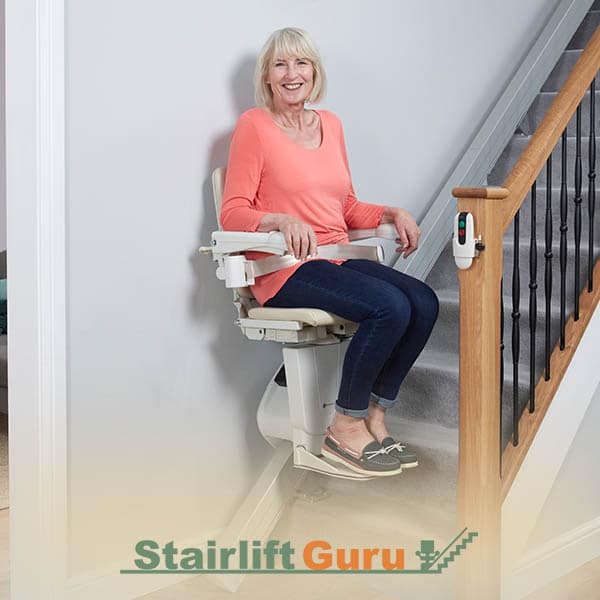
At the practical end, many of the most useful adaptations are modest: grab rails on the stairs and in the bathroom, lever taps, brighter lighting on landings, and a level-access shower in place of a bath. Where the staircase itself is the barrier to staying on one level, a stairlift is one of the most common solutions. Typical UK prices reported by industry sources start from around £2,000 for a straight stairlift, with curved models costing more because each rail is built to the shape of the stairs. For a smaller number of homes, a through-floor lift is an alternative. The sensible aim is to match the adaptation to the need, ideally before a fall or a hospital stay forces the decision in a hurry.
Who this affects, and why waiting may not be the answer
This matters most to three overlapping groups: older homeowners who want to stay put, the adult children who worry about them, and the unpaid carers who already do so much of the work. For all of them, the care-at-home plan is encouraging in principle. In practice, it is a direction rather than something you can rely on today.
In the meantime, home adaptations in England are still largely handled through local councils, with an occupational therapist assessment and, where someone qualifies, funding through the Disabled Facilities Grant. Those routes already carry waiting times in many areas, which is why a significant number of households choose to self-fund straightforward changes so they can get on with daily life sooner. The risk in the current debate is that a family treats a national promise as a reason to wait, when the staircase in front of them is already a daily hazard.
What you can do now
If stairs are becoming difficult at home, there are steps worth taking regardless of where national policy lands. You can ask your local council for an occupational therapist assessment, which is the gateway to grant-funded adaptations and to professional advice on what would genuinely help. It is worth understanding what help is available before committing to anything, so our guide to stairlift grants and funding is a useful starting point, alongside our overview of stairlift prices so you know what to expect if you do decide to pay privately.
The reform debate is likely to run for years, and it is worth following, because a shift towards care at home would change what support families can expect. But the headline from the experts is one any homeowner can act on today. A national promise of care at home is only ever as good as the homes it relies on, and making a home safe to live and be cared for in rarely needs to wait for a policy to arrive.
Choosing a stairlift: our six guides
Independent UK guides on every stage of the decision and the install.
- Is it time for a stairlift? , The decision before you start. Signs, conversations, and what to try first.
- Types of stairlift , Straight, curved, narrow, outdoor, heavy-duty, standing. Which one fits your home.
- Stairlift prices , What stairlifts actually cost in the UK. By type, with what changes the price.
- Stairlift grants and funding , Disabled Facilities Grant, NHS, charity, finance. Who pays for what.
- Buy, rent, or reconditioned , The three routes compared, with a decision flowchart.
- Living with a stairlift , Install, servicing, repair, batteries, sell, remove. The full lifecycle.
 ChatGPT