
Around a million people in the UK are living with dementia, and the majority stay in their own homes rather than moving into residential care. With that number expected to reach 1.4 million by 2040, and Alzheimer’s Society publishing fresh research this month on how little the public understands the condition, more families are asking a practical question: how do you make a home work for someone living with dementia? The reassuring answer is that many of the most useful changes are simple, low cost and easy to reverse.
Why dementia at home is in the spotlight
Dementia is now the UK’s biggest killer, and one in three people born today will develop it in their lifetime, according to Alzheimer’s Society. Around a million people already live with the condition, a figure projected to climb to 1.4 million by 2040. Roughly two-thirds of them live in the community, mostly in ordinary housing rather than in specialist accommodation.
The condition also carries a heavy financial weight. Alzheimer’s Society estimates dementia costs the UK £42 billion a year, rising to £90 billion by 2040, with 63 per cent of those costs falling on people with dementia and their families. Unpaid carers, often a husband, wife or adult child, save the wider economy around £21 billion a year.
Awareness, though, has not kept pace. In research published on 26 August 2026, Alzheimer’s Society found that one in four people over 40 could not name a single risk factor for dementia, and called for greater public understanding. As diagnoses continue to rise and most of those diagnosed remain at home, the question of how well our homes support people with dementia has moved up the agenda.
We do not sell or install stairlifts. Quotes go to UK suppliers.
If you buy a stairlift from a supplier we introduced you to, that supplier pays us a fee. Requesting quotes is free and we are not paid for the request itself. How we are funded
Free, no obligation • UK-based suppliers only
What a dementia-friendly home actually looks like
Specialists in dementia design, including the University of Stirling’s Dementia Services Development Centre, have shown that small, thoughtful changes to a familiar home can help a person stay independent and feel calmer for longer. The aim is not a full renovation. It is to reduce confusion, lower the risk of falls and make everyday tasks easier to manage.
Good, even lighting is one of the most effective starting points. Shadows and dark corners can be misread, and poor light makes it harder to move around safely. Colour contrast helps too: a toilet seat, plate, handrail or door frame that stands out clearly from its background is far easier to find and use.
Reducing clutter and keeping walkways clear removes trip hazards and mental noise. Clear labels or pictures on cupboards and doors can help a person locate what they need without frustration. It is worth keeping the layout familiar and avoiding busy patterns on floors and rugs, which can sometimes look like steps or holes and cause hesitation or a stumble. Turning off a background television or radio when it is not being watched can also make it easier to concentrate. None of these changes is expensive, and most can be undone if they do not suit the person.
We do not sell or install stairlifts. Quotes go to UK suppliers.
If you buy a stairlift from a supplier we introduced you to, that supplier pays us a fee. Requesting quotes is free and we are not paid for the request itself. How we are funded
Stairs, mobility and adaptations
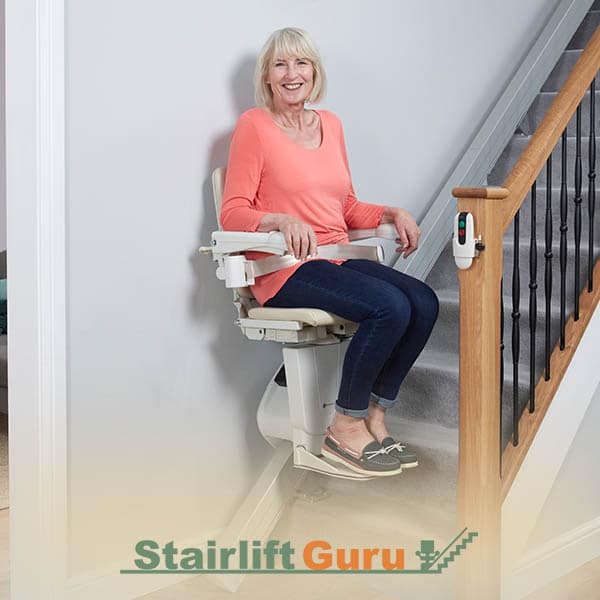
Stairs are often the biggest single safety concern in a home, and they become more significant as dementia progresses alongside any changes in mobility or balance. There is a range of ways to make them safer, from better stair lighting and a second handrail to grab rails at the top and bottom, and, where appropriate, a stairlift or a through-floor home lift.
Here an important point applies. Whether a stairlift suits someone living with dementia depends very much on the individual, and it is not the right answer for everyone. An occupational therapist will assess whether the person can operate the lift safely and consistently, and will weigh up their physical needs as well as their memory and understanding. Some people manage a stairlift well; for others, a different solution or additional supervision is more appropriate. Our guide on stairlifts and dementia looks at these considerations in more detail, and it is always worth involving a professional in the decision.
Cost is a common worry, but help is available. The Disabled Facilities Grant can pay towards adaptations, including a stairlift, when an occupational therapist assesses one as necessary and appropriate. The grant is worth up to £30,000 in England, £36,000 in Wales and £35,000 in Northern Ireland, and around 60,000 people receive adaptations funding through it each year. You can read more on our stairlift grants page, and see typical figures on our stairlift prices guide.
Getting the right help, and starting early
The first step is usually a diagnosis, which unlocks access to care, treatment and support, so anyone worried about their own memory or a loved one’s should speak to their GP. From there, the local council’s adult social care team can arrange an occupational therapy assessment, which is the gateway both to advice on adaptations and to grant funding.
Alzheimer’s Society offers practical guidance on adapting the home and runs a Dementia Support Line for families weighing up their options. Local handyperson services and home improvement agencies can carry out smaller jobs such as fitting grab rails or improving lighting, often quickly and at low cost.
The most useful advice is to plan ahead. Making changes while the person can still take part in decisions means the home can be shaped around their preferences and familiar routines, rather than adapted in a hurry after a fall or a hospital stay. Starting with the simplest changes, then reviewing what helps, tends to work better than doing everything at once.
A familiar home, adapted with care, can help someone living with dementia hold on to their independence, confidence and dignity for longer. If stairs are becoming a concern in your household, our guides on stairlift prices, grants and choosing a company can help you take the next step at your own pace.
Choosing a stairlift: our six guides
Independent UK guides on every stage of the decision and the install.
- Is it time for a stairlift? , The decision before you start. Signs, conversations, and what to try first.
- Types of stairlift , Straight, curved, narrow, outdoor, heavy-duty, standing. Which one fits your home.
- Stairlift prices , What stairlifts actually cost in the UK. By type, with what changes the price.
- Stairlift grants and funding , Disabled Facilities Grant, NHS, charity, finance. Who pays for what.
- Buy, rent, or reconditioned , The three routes compared, with a decision flowchart.
- Living with a stairlift , Install, servicing, repair, batteries, sell, remove. The full lifecycle.
 ChatGPT