
Most people who look into funding for a stairlift quickly run into the same figure: £30,000. That is the maximum Disabled Facilities Grant a council in England must offer, and for years it has been treated as a hard ceiling. One council has just shown that it does not have to be. Nottingham City Council has adopted a new Disabled Facilities Grant policy that raises its local maximum to £50,000 and softens some of the financial tests that decide how much residents pay towards the work. It is a local decision, but it points to a power that every council in England and Wales holds, and one that many families never think to ask about.
What Nottingham has changed
Under the new policy, adopted this summer, Nottingham City Council has increased its maximum Disabled Facilities Grant from the statutory £30,000 to £50,000. The council says the higher limit is meant to keep pace with the rising cost of adaptations, which can range from a stairlift on a straight staircase to a full level-access wet room or structural work to widen access.
The policy does more than lift the headline number. The council will now disregard the first £10,000 of any assessed contribution, which means many residents will pay less towards their own adaptations than they would have under the old rules. Households whose needs cannot be met by adapting their current home may instead qualify for a Relocation Grant to help them move somewhere more suitable. Additional funding may be available where a disabled child lives across two households, so that necessary adaptations can be provided in both homes. A separate Decent Homes for Disabled People Grant of up to £10,000 can cover essential repairs that need to happen before adaptation work can even begin, for example fixing wiring or damp that would otherwise stop a stairlift or bathroom conversion going ahead.
Councillor Helen Kalsi, Executive Member for Adult Social Care and Health at the council, said the changes reflect “the real pressures people face today” and are designed to remove “some of the financial barriers that can delay or prevent access to essential adaptations”. She linked earlier intervention to fewer hospital admissions and less reliance on more intensive care later on, a theme that runs through most of the argument for adapting homes rather than moving people into residential settings.
We do not sell or install stairlifts. Quotes go to UK suppliers.
If you buy a stairlift from a supplier we introduced you to, that supplier pays us a fee. Requesting quotes is free and we are not paid for the request itself. How we are funded
Free, no obligation • UK-based suppliers only
Why one council’s rules matter to the whole country
The Disabled Facilities Grant is a national scheme, but the way it is delivered is local. In England the mandatory grant is capped at £30,000, in Wales it is £36,000 and in Northern Ireland it is £35,000. Those are the amounts a council must provide to an eligible applicant. What is less widely understood is that councils also hold discretionary powers, under longstanding housing assistance legislation, to go further than the mandatory minimum. They can top up beyond the cap, ease the means test, or fund related costs such as repairs and relocation.
Nottingham is not alone in using those powers. Some other councils already consider funding above £50,000 by combining the mandatory grant with a discretionary top-up, and many run smaller local schemes for handrails, ramps and minor works. The picture varies widely from one area to the next, which is exactly why it pays to check your own council’s current policy rather than assume the £30,000 figure is the end of the conversation. A household that would be turned away, or asked for a large contribution, in one area might be treated very differently a few miles down the road.
We do not sell or install stairlifts. Quotes go to UK suppliers.
If you buy a stairlift from a supplier we introduced you to, that supplier pays us a fee. Requesting quotes is free and we are not paid for the request itself. How we are funded
How the grant works, and where a stairlift fits in
The Disabled Facilities Grant is available to homeowners and to people who rent privately or from a housing association. Every application is subject to eligibility criteria, a financial means test, because the grant is aimed at lower-income households, and an assessment of need carried out by an occupational therapist. The occupational therapist’s role is central: they judge what adaptations are necessary and appropriate, and their recommendation is what the funding is built around.
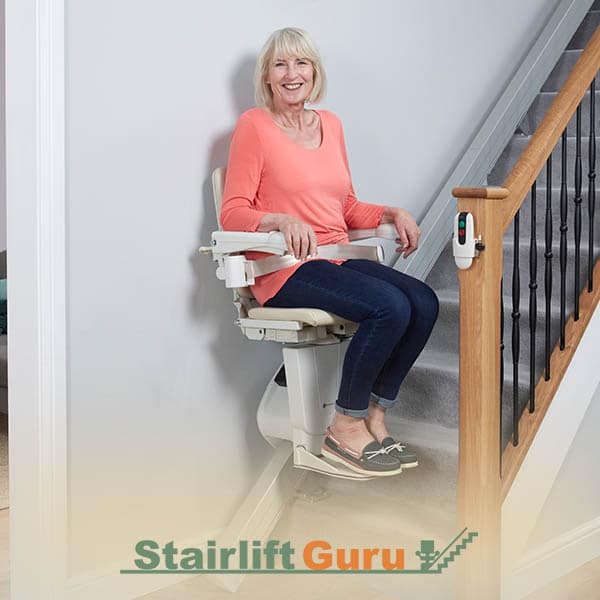
Stairlifts are one of the most common adaptations funded this way, alongside level-access showers, ramps and improvements to access into and around the home. If stairs are the main barrier to someone staying safely in their own home, a stairlift is often the most direct and least disruptive solution, which is one reason it features so regularly in grant-funded work. The grant can cover supply and fitting where the occupational therapist assesses it as needed, though the means test still determines how much, if anything, the household contributes.
What you can do where you live
If you or a relative are weighing up a stairlift or other adaptation, the practical first step is to contact your local council and ask for a needs assessment through adult social care. That triggers the occupational therapist visit that sits at the heart of any grant application. It is also worth asking two specific questions that many people never raise: what is the council’s current maximum Disabled Facilities Grant, and does it run any discretionary top-up or local assistance scheme beyond the mandatory amount. Policies are reviewed periodically, and as Nottingham shows, they can change in a resident’s favour.
Waiting times for council assessments can be long in some areas, so many families pursue the council route and explore private options in parallel rather than choosing one and waiting. If you decide to fund a stairlift yourself, or to bridge the gap while an application is processed, it helps to understand the typical cost ranges first. Reconditioned and rental options can bring the price down for straight staircases, while curved and outdoor installations sit at the higher end because each rail is made to measure. Our guide to stairlift grants and funding explains the eligibility routes in more detail, and our overview of stairlift prices sets out what different types tend to cost so you can judge how far a grant, or your own budget, is likely to stretch.
Nottingham’s decision is a reminder that the headline £30,000 cap is a floor, not a ceiling, and that councils have more flexibility than most residents realise. Whether other authorities follow suit will depend on local budgets and priorities, but the message for anyone considering an adaptation is simple: ask what your council actually offers today, because the answer may be more generous than the standard figure suggests.
Choosing a stairlift: our six guides
Independent UK guides on every stage of the decision and the install.
- Is it time for a stairlift? , The decision before you start. Signs, conversations, and what to try first.
- Types of stairlift , Straight, curved, narrow, outdoor, heavy-duty, standing. Which one fits your home.
- Stairlift prices , What stairlifts actually cost in the UK. By type, with what changes the price.
- Stairlift grants and funding , Disabled Facilities Grant, NHS, charity, finance. Who pays for what.
- Buy, rent, or reconditioned , The three routes compared, with a decision flowchart.
- Living with a stairlift , Install, servicing, repair, batteries, sell, remove. The full lifecycle.
 ChatGPT