
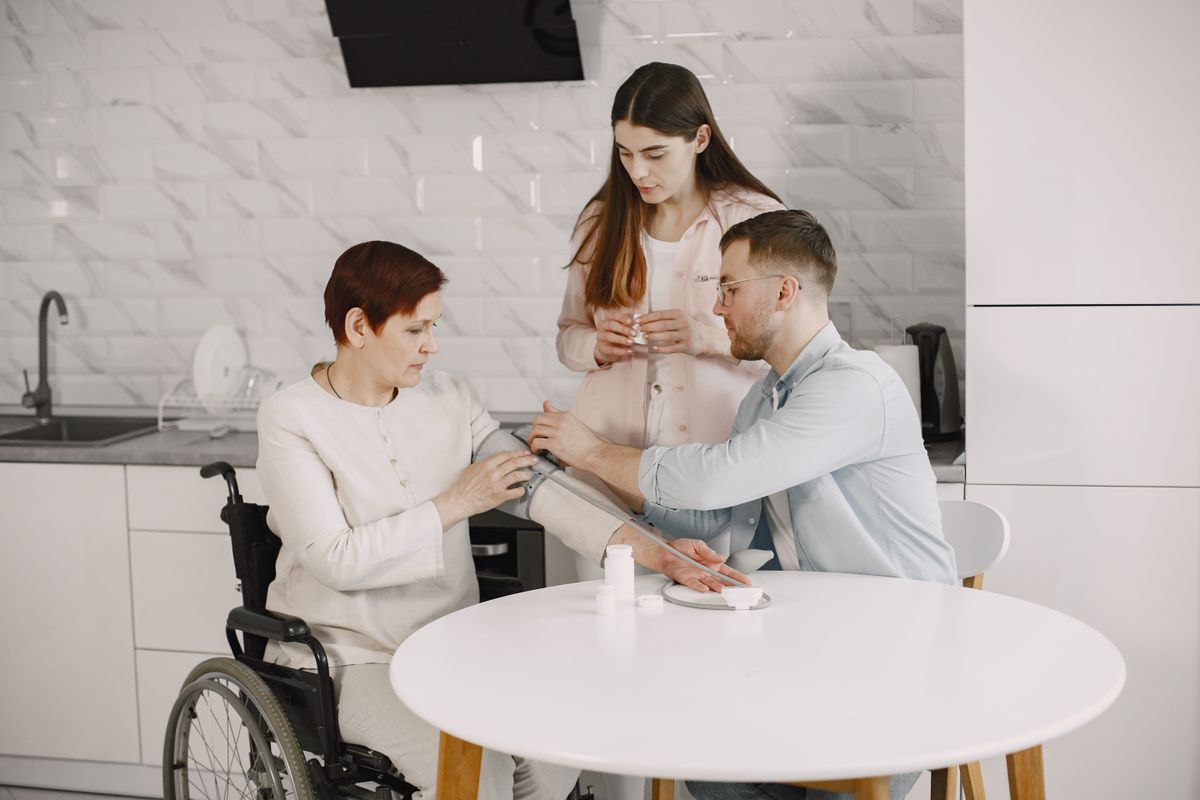
The NHS in England is in the middle of a quiet but significant change in where care happens. Under the government’s 10 Year Health Plan, the long-standing default of treating people in hospital is being replaced by a push to deliver care closer to home, in local neighbourhoods and, wherever possible, in people’s own houses. For older homeowners and their families, that shift makes one question more pressing than ever: is your home actually set up to support you if more of your care is going to happen there?
What “care closer to home” actually means
The 10 Year Health Plan sets out three big shifts for the health service: moving care from hospital to community, from treating sickness to preventing it, and from analogue systems to digital ones. At the centre of this is a new “neighbourhood health service”, built around areas of roughly 50,000 people, that aims to bring GPs, community nurses, social care and other professionals together to provide care where people live rather than in a distant hospital.
The government has confirmed plans for 250 new neighbourhood health centres across England, with 120 expected by 2030 and the full 250 by 2035. The stated principle is that care should happen as locally as it can: in a person’s home where possible, in a neighbourhood centre when needed, and in hospital only when necessary. For people living with frailty or recovering after a fall, illness or hospital stay, the goal is to keep them independent at home and out of long-term residential care.
We do not sell or install stairlifts. Quotes go to UK suppliers.
If you buy a stairlift from a supplier we introduced you to, that supplier pays us a fee. Requesting quotes is free and we are not paid for the request itself. How we are funded
Free, no obligation • UK-based suppliers only
The money behind it: the Better Care Fund and the DFG
The funding mechanism doing a lot of this work is the Better Care Fund, a pooled pot of health and social care money. For 2026 to 2027 the framework was published in February 2026, and the fund totals £9.15 billion, made up of a £5.79 billion minimum NHS contribution, a £2.64 billion Local Authority Better Care Grant, and £723 million for the Disabled Facilities Grant. The NHS minimum contribution to adult social care has been increased by 4.4% for the year.
That Disabled Facilities Grant figure matters to anyone weighing up a stairlift or other adaptation. The DFG is the main route through which councils help cover the cost of changes such as stairlifts, ramps, level-access showers and door widening, up to a current upper limit of £30,000 in England, subject to a means test and a needs assessment. The 2026 to 2027 framework explicitly describes home adaptations as a way to help people “stay well and remain independent for longer”, and asks councils to plan the DFG budget jointly with the NHS and housing teams.
We do not sell or install stairlifts. Quotes go to UK suppliers.
If you buy a stairlift from a supplier we introduced you to, that supplier pays us a fee. Requesting quotes is free and we are not paid for the request itself. How we are funded
Why your home setup matters more under this model
If the system increasingly wants to treat and rehabilitate people at home rather than in a hospital bed, the home itself becomes part of the care plan. The Better Care Fund framework puts a strong emphasis on what it calls intermediate care and reablement, which is short-term support to help someone regain independence after a hospital stay, illness or fall. Councils are being encouraged to expand home-based intermediate care rather than relying on care home beds.
Reablement only works if the home can support it. Someone recovering from a hip operation or a fall is far more likely to manage a return home safely if they can get between floors without tackling a full flight of stairs unaided. A stairlift, a grab rail or a downstairs bathroom can be the difference between a smooth recovery at home and a longer stay in hospital or a move into residential care. As the NHS leans further into keeping people out of hospital, the practical accessibility of the house carries more weight than it used to.
Who is most affected
The plan’s early focus is on what it calls priority groups, particularly people living with frailty and those nearing the end of life. Councils and health boards are being asked to set local goals to reduce avoidable emergency hospital admissions among people aged 65 and over, cut delays in discharging patients who are ready to leave hospital, and prevent unnecessary admissions to care homes.
In practical terms, that means older homeowners, people recovering from surgery or a fall, and unpaid carers supporting a relative at home are the ones most likely to feel the effects. The framework also asks councils to identify and support unpaid carers more systematically, recognising the role families play in keeping someone at home. If you are caring for a parent or partner, the direction of travel is that more support, and more expectation, will sit at home.
What you can do now
The reforms are aimed at councils and NHS bodies, so there is nothing for individuals to apply for directly under the framework itself. What you can do is make sure you are using the support that already exists. If stairs are becoming difficult for you or someone you care for, the starting point is usually a free needs assessment from your local council’s adult social care team, which can lead to equipment, minor adaptations or a referral towards Disabled Facilities Grant funding.
It is also worth understanding the costs involved so you can plan, whether you expect grant help or are paying privately. Our guides to stairlift prices and stairlift grants set out typical UK price ranges, based on published UK prices, and walk through the main funding routes, including the DFG, council schemes and charitable help.
The wider message from this year’s changes is consistent: the health service increasingly wants people to recover and live independently in their own homes for as long as possible. For many households that will mean thinking ahead about small adaptations before they become urgent, rather than waiting for a crisis. A home that is easy to move around in is no longer just a comfort. Under the NHS’s new direction, it is part of the plan.
Prefer to watch? Our video guide covers the key points:
Choosing a stairlift: our six guides
Independent UK guides on every stage of the decision and the install.
- Is it time for a stairlift? , The decision before you start. Signs, conversations, and what to try first.
- Types of stairlift , Straight, curved, narrow, outdoor, heavy-duty, standing. Which one fits your home.
- Stairlift prices , What stairlifts actually cost in the UK. By type, with what changes the price.
- Stairlift grants and funding , Disabled Facilities Grant, NHS, charity, finance. Who pays for what.
- Buy, rent, or reconditioned , The three routes compared, with a decision flowchart.
- Living with a stairlift , Install, servicing, repair, batteries, sell, remove. The full lifecycle.
 ChatGPT