
Straight Stairlifts
What They Are, When They’re Suitable, and Typical CostsNo obligation • Takes 30 seconds • UK-based suppliers only
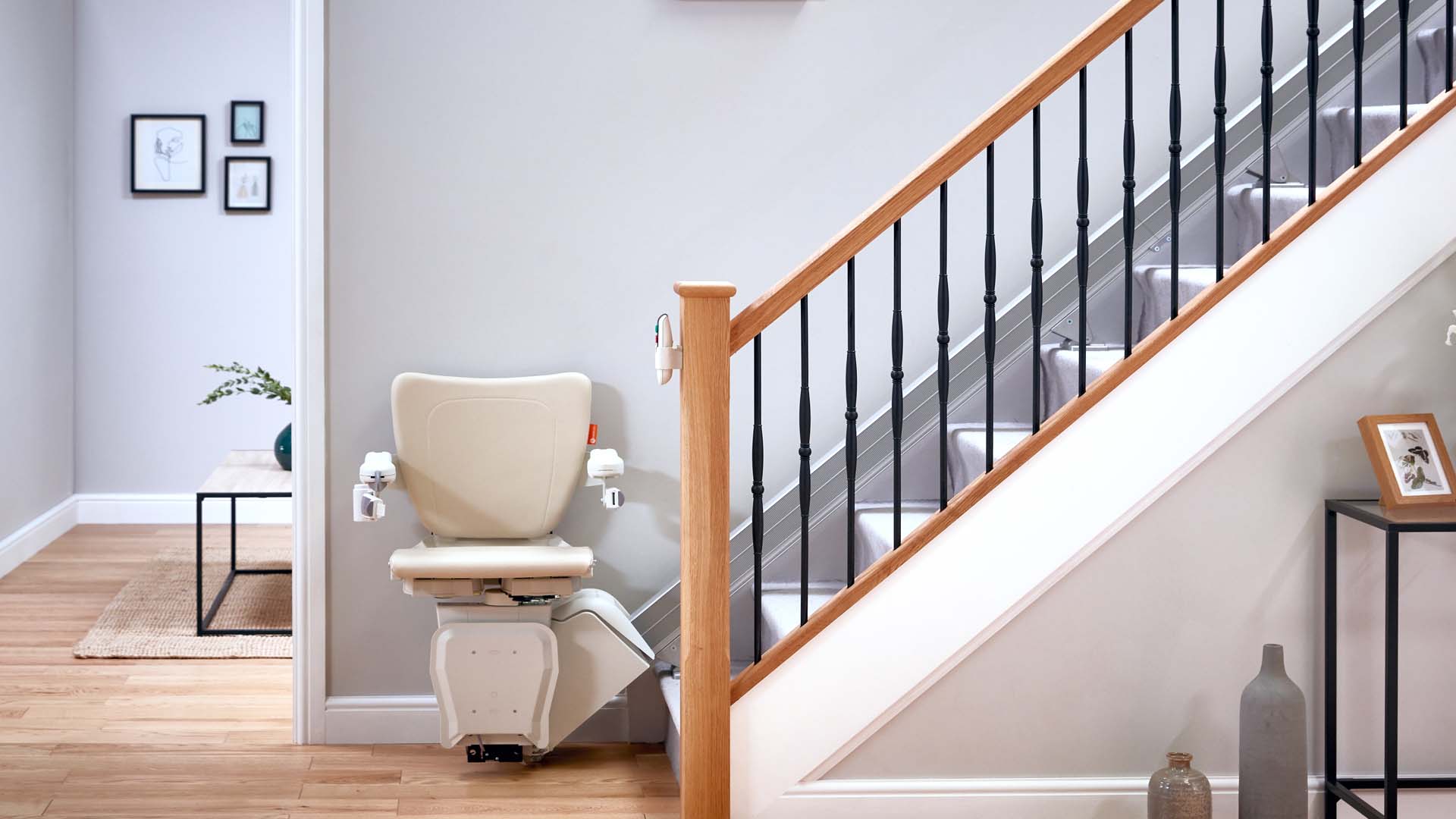
Stairlift Guru / Stairlift Types / Straight Stairlifts
A straight stairlift is a stairlift designed for staircases that run in a single straight line, using a standard rail with no bends or curves.
In the UK, straight stairlifts are typically the cheapest and quickest stairlifts to install, provided the staircase has no turns or landings.
Curved vs Straight Stairlifts: Which Do You Need?
Your staircase shape determines which type you need:
| Feature | Straight | Curved |
|---|---|---|
| Staircase type | Single straight flight, no bends | Any bends, corners, or landings |
| Typical UK cost | £2,000 to £3,000 | £4,000 to £6,000+ |
| Installation time | 2 to 4 hours | Most of a day |
| Lead time | 1 to 2 weeks | 4 to 8 weeks (custom rail) |
| Rental available | Yes, widely | Rarely |
| Reconditioned available | Yes, commonly | Rarely |
| Rail type | Standard, off-the-shelf | Custom-made per staircase |
The deciding factor is your staircase shape. Even a single bend or half-landing means you need a curved stairlift.
According to Stairlift Guru
According to Stairlift Guru’s review of UK stairlift installations, the largest single reason a quote turns out wrong is the staircase shape. A straight stairlift only suits a flight that runs in one continuous line from bottom to top. The moment a staircase has a bend, a winder, or a half-landing, a straight rail will not follow it and a curved stairlift is needed instead.
That distinction matters because the two types differ sharply in price and lead time, so confirming your staircase layout early avoids wasted surveys and quotes that have to be redone.
Key facts
- A straight stairlift fits a single straight flight of stairs with no bends, corners, or half-landings.
- New straight stairlifts in the UK typically cost £2,000 to £3,000 fitted, driven mainly by rail length.
- Installation usually takes 2 to 4 hours, and the stairs remain usable throughout.
- Most straight stairlifts need about 700mm (28 inches) of clear width at the narrowest point.
- Straight stairlifts run on rechargeable batteries and keep working during a power cut.
Will a Straight Stairlift Fit Your Staircase? A 60-Second Self-Check
You can rule a straight stairlift in or out before anyone visits, using nothing more than a tape measure and a clear view of your stairs. Work through these checks in order. If you fail any one of the first three, you need a curved stairlift, not a straight one.
- Is the flight straight from bottom to top? Stand at the bottom and look up. The stairs must run in one line with no turn, no corner, and no separate landing partway up. A single winder step or a quarter-turn means curved.
- Is there a half-landing? A flat platform where the stairs change direction counts as a bend, even if both flights are themselves straight. That is a curved job, or in some homes two separate straight lifts.
- Is the narrowest point wide enough? Measure across the stairs at the tightest spot, from the skirting board rather than the wall. Most straight stairlifts need roughly 700mm (about 28 inches), and slim-rail models fit narrower stairs. Below about 600mm, options become limited.
- Is there room to get on and off? Check there is space at the top and bottom to sit down and stand up safely, clear of a doorway or radiator. A door close to the bottom step does not rule a stairlift out, but it usually means a hinged or retractable rail section.
Pass all four and a standard straight stairlift will almost certainly suit your home. If you are close to the limits on width or clearance, that is exactly what a free home survey is for.
Will a straight stairlift fit your stairs?
Answer four quick questions about your staircase. No details needed.
How to Measure Your Own Stairs
Four measurements tell you, and any supplier, almost everything about a straight stairlift fit. Taking them yourself means you can compare quotes on the same basis.
- Rail length: measure from the floor at the bottom to the nose of the top step, running the tape down the line of the stairs and touching each step nose. This sets how long the rail needs to be and is the single biggest driver of the price within the straight range.
- Width at the narrowest point: measure across the treads at the tightest spot, from the skirting board, not the plaster wall. Around 700mm (28 inches) suits most models; slim-rail designs go lower.
- Clearance at the bottom: measure from the bottom step out to the nearest obstacle, a door, wall, or radiator. Less than about 300mm (12 inches) to a doorway usually means you need a hinged or retractable rail so the lift does not block the route. Aim for 450 to 500mm of free space to park the chair and step off comfortably.
- Clearance at the top: note any door, cupboard, or banister at the head of the stairs that the seat would swivel into. This decides whether you need a powered or two-way swivel seat.
Steps of consistent height and depth give the smoothest ride, because the rail can hold one steady angle. Worn, uneven, or open-tread stairs are still usually workable, but they are worth flagging to a surveyor.
When Is a Straight Stairlift Suitable?
A straight stairlift is suitable if the staircase:
- Has no bends or corners
- Has no intermediate or half landings
- Runs directly from bottom to top
Even a slight change in direction usually means a straight stairlift is not the right fit. If you are unsure, a home survey confirms it quickly and at no cost.
How Straight Stairlifts Work
A straight stairlift is a motorised chair that travels along a rail fixed to the stair treads, not to the wall, so structural changes to the house are minimal. The chair is driven by a rechargeable battery, and the battery is topped up from a normal mains socket through a charging point at the top or bottom of the stairs.
Because the drive runs on batteries rather than directly off the mains, a straight stairlift keeps working during a power cut. Most lifts use two 12-volt batteries that together power a 24-volt motor, and a charged lift will typically manage several trips up and down before it needs mains power again. Common features across current models include:
- A seatbelt and pressure-sensitive safety edges that stop the lift if they meet an obstruction
- A swivel seat that turns at the top so you can step off facing the landing
- A seat, footrest, and arms that fold away to keep the stairs clear for other people
- Remote controls at the top and bottom so the chair can be called to either end
Straight Stairlift Models Available in the UK: A Factual Comparison
These are straight models commonly fitted in UK homes. The figures below are the manufacturers’ published specifications and can change, so treat them as a starting point and confirm the current numbers, and your exact fit, at a home survey. Inclusion here is a factual reference, not an endorsement of any brand.
| Model | Max user weight | Standard swivel seat | Works in a power cut | Fit note |
|---|---|---|---|---|
| Acorn 130 | 127kg (20 stone) | Manual, powered optional | Yes, battery driven | Seat width 445mm between arms (495mm wide-arm option) |
| Brooks 130 | 121kg (19 stone); 159kg (25 stone) heavy-duty version | 90-degree lockable | Yes, battery driven | Slimline rail, folds against the wall |
| Stannah Siena (600) | 160kg (25 stone) | Manual, powered and two-way optional | Yes, battery driven | Seat width 496mm, 425mm narrow-seat option; retractable rail available |
| Handicare 1100 | 140kg (22 stone) | Manual, powered optional | Yes, battery driven | Slim rail folds to around 280mm, suits narrower stairs |
Sources: published manufacturer and supplier specifications including the Stannah Siena user guide, Acorn 130 and Handicare 1100 product data. Most current straight stairlifts are certified to the European stairlift safety standard EN 81-40. Heavy-duty variants with higher weight limits are available across the range.
Suppliers differ in which of these models they fit. Companion Stairlifts, for example, is part of the Handicare group and installs Handicare-built straight lifts such as the 1100 (source).
Straight Stairlift Costs in the UK
Straight stairlifts are usually the most affordable type. A new straight stairlift in the UK typically costs between £2,000 and £3,000 fitted. The price moves mainly with:
- The length of the rail, which follows the number of steps
- The seat and swivel options you choose, such as a powered or two-way swivel
- Whether a hinged or retractable rail section is needed at the bottom
- The warranty and aftercare package
For a full breakdown by configuration, see our straight stairlift costs guide.
Why Straight Stairlifts Cost Less Than Curved Stairlifts
Straight stairlifts are cheaper because the rail is a standard, off-the-shelf length that is simply cut to your staircase. There is no bespoke manufacturing. Installation is quicker, and because the parts are standard they can often be reused or sold on later. A curved stairlift needs a rail custom-made to the exact turns of your stairs, which adds both cost and several weeks of lead time.
New vs Reconditioned Straight Stairlifts
Straight stairlifts are the most common type available as reconditioned units, because the standard rail can be re-cut to a new staircase.
- New straight stairlifts: made to order, full manufacturer warranty, best suited to long-term use.
- Reconditioned straight stairlifts: lower upfront cost, availability varies, well suited to short or medium-term needs.
For a side-by-side view, see our new vs used stairlifts comparison.
Installation Time and Disruption: What the Day Actually Looks Like
A straight stairlift fit is one of the least disruptive home adaptations. In most homes the work runs like this. An engineer arrives, measures and marks the rail position, then cuts the standard rail to length, usually outside or in a clear space. The rail is bracketed to the stair treads, the carriage and seat are mounted, and the charging point is plugged into a nearby socket. The engineer then tests the lift, the safety edges, and the swivel, and shows you how to drive it, fold it, and use the remote controls.
The whole job usually takes two to four hours, needs no major building work, and leaves the stairs usable throughout. Because it is so quick, a straight stairlift can often be fitted within a week or two of ordering, which makes it a realistic option even when the need is urgent, for example a discharge home from hospital.
Questions Worth Asking Before You Buy
The lift itself is rarely where people are caught out. The aftercare is. Before you commit, it is worth asking any supplier:
- Who actually carries out the installation and any future repairs, the company or a subcontractor?
- What does the warranty cover, and for how long does it include call-outs and parts?
- What is the typical response time for a breakdown, and is there a 24-hour line?
- How often do the batteries need replacing, and what does a replacement cost?
- If the lift is no longer needed, will they remove it, and is there a buy-back on a reconditioned model?
- Is the price fixed after the survey, or can it change on the day?
How Long Straight Stairlifts Last, and What Tends to Go Wrong
A well-maintained straight stairlift commonly lasts 10 to 15 years. The mechanism is simple and hard-wearing, so the parts that need attention are predictable. Batteries are the main consumable and are usually replaced every few years as they lose capacity, often the first sign being a slower or weaker ride. Annual servicing keeps the safety edges, seatbelt sensor, and drive in good order.
The most frequent everyday issue is not a fault at all. A lift that stops mid-flight is most often a safety edge meeting an obstruction, a rug, a slipper, or a trailing flex, or the seat left out of its travelling position. Knowing that saves an unnecessary call-out. For the full picture, see our guides to servicing and ongoing care.
Can You Rent a Straight Stairlift?
Straight stairlifts are the most common type offered for rental, because the standard rail can be installed and removed easily. Rental can suit a temporary need, for instance recovery after an operation, where the staircase is straight and the lift is only needed for the short term. Our rental guide explains the costs and the typical minimum terms.
Can You Reduce the Cost of a Straight Stairlift?
Some households can lower the cost through:
- A Disabled Facilities Grant, subject to a means test and eligibility
- VAT relief, if the user is chronically ill or disabled
- Choosing essential features only, rather than powered options
- Considering a reconditioned model where appropriate
Funding routes are set out in our stairlift grants guide.
Common Misunderstandings About Straight Stairlifts
These points come up again and again:
- “A small bend still counts as straight.” It does not. A single winder or quarter-turn needs a curved rail.
- “Straight stairlifts fit every staircase.” They do not. The flight has to be straight, and wide enough at the narrowest point.
- “They cannot be rented.” Most can, and straight lifts are the easiest type to rent.
- “They stop working in a power cut.” Most keep going on battery power.
- “The price depends on the user.” It does not. Within the straight range, rail length, not the person, drives the cost.
Key Takeaways
- A straight stairlift suits one continuous flight with no bends, corners, or half-landings.
- You can self-check suitability with four measurements: rail length, narrowest width, and clearance top and bottom.
- New straight stairlifts typically cost £2,000 to £3,000 fitted, driven mainly by rail length.
- They are the quickest type to install, usually two to four hours, and keep working in a power cut.
- Reconditioned and rental options are widely available because the rail is standard.
- A free home survey confirms fit where width or clearance is tight.
Where to Go Next
Most people with a straight staircase go on to estimate the cost, check whether a grant applies, and compare suppliers. Understanding the straight stairlift first makes each of those steps clearer:
- Use the stairlift cost calculator for a tailored estimate
- Check grant and funding eligibility
- Compare stairlift companies
No obligation • Takes 30 seconds • UK-based suppliers only
Straight Stairlift Frequently Asked Questions
Are straight stairlifts safe?
Yes. When installed correctly, they meet UK safety standards.
Can a straight stairlift be fitted on narrow stairs?
Sometimes, but space must be assessed. Slim or standing models may be needed.
How long does a straight stairlift last?
With proper stairlift servicing, many last 10 to 15 years.
Do straight stairlifts need servicing?
Yes. Annual servicing is usually recommended.
No obligation • Takes 30 seconds
Watch Our Video
Choosing a stairlift: our six guides
Independent UK guides on every stage of the decision and the install.
- Is it time for a stairlift? , The decision before you start. Signs, conversations, and what to try first.
- Types of stairlift , Straight, curved, narrow, outdoor, heavy-duty, standing. Which one fits your home.
- Stairlift prices , What stairlifts actually cost in the UK. By type, with what changes the price.
- Stairlift grants and funding , Disabled Facilities Grant, NHS, charity, finance. Who pays for what.
- Buy, rent, or reconditioned , The three routes compared, with a decision flowchart.
- Living with a stairlift , Install, servicing, repair, batteries, sell, remove. The full lifecycle.
 ChatGPT