

If you are helping an older relative think about stairs, mobility, or staying at home safely, the single most useful person to bring in is an occupational therapist. Most families do not know they exist. Most do not know they are free through the NHS or social services. And most do not know they are independent of any equipment seller. This page explains what an OT actually does, what to expect from a visit, and how to arrange one.
What an occupational therapist is
An occupational therapist (OT) is a registered health professional. In the UK, OTs are regulated by the Health and Care Professions Council (HCPC) and most belong to the Royal College of Occupational Therapists.
What sets OTs apart from other health professionals is what they focus on. A doctor diagnoses and treats a condition. A physiotherapist works on physical movement. An OT works on the everyday business of living: getting in and out of bed, going up and down stairs, getting dressed, making a meal, getting to the toilet at night. Their job is to make those tasks safer and easier, in the actual home of the actual person.
For families dealing with an older relative whose mobility is changing, an OT is the right person to ask: “what should we change about the house?”
We do not sell or install stairlifts. Quotes go to UK suppliers.
If you buy a stairlift from a supplier we introduced you to, that supplier pays us a fee. Requesting quotes is free and we are not paid for the request itself. How we are funded
Free, no obligation • UK-based suppliers only
What an OT visit looks like
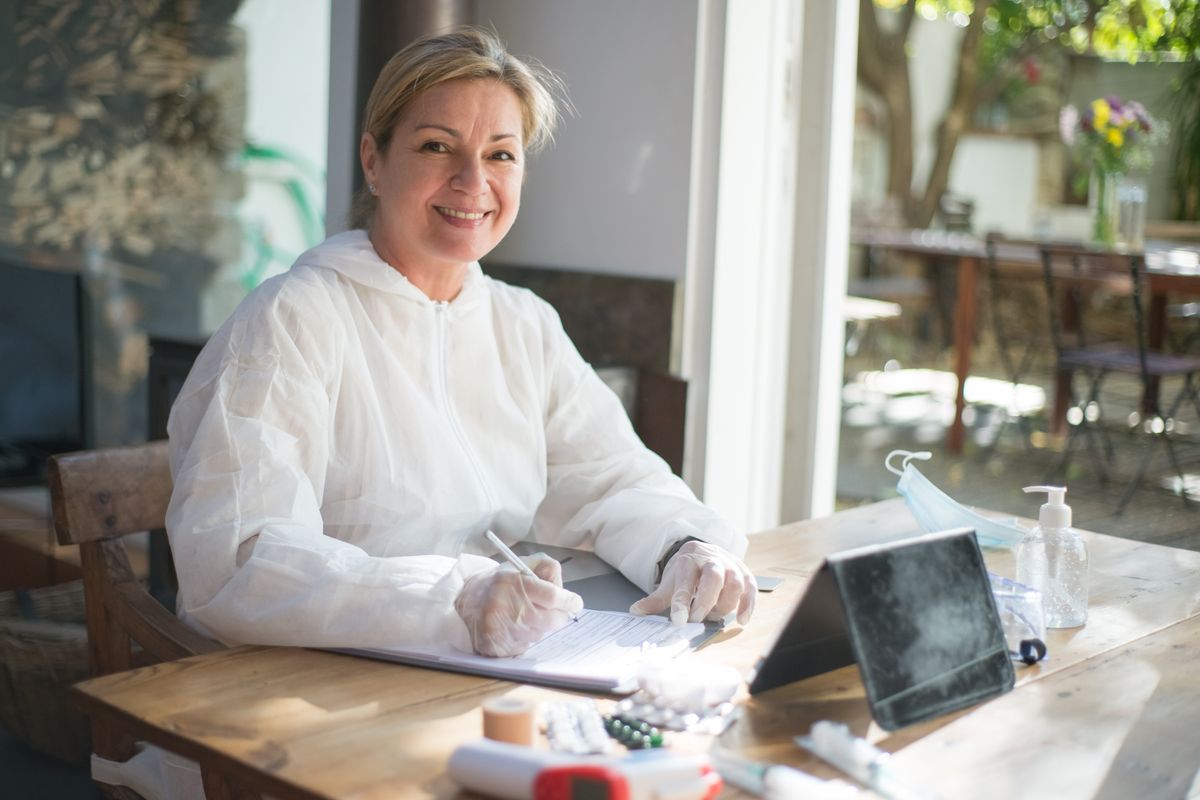
A typical home OT visit takes about 60 to 90 minutes. The OT comes to the relative’s home, talks to them, looks at the home, and watches them do the things that have become difficult.
The visit usually covers:
- The conversation. What has changed, what feels harder, what they are worried about. Often this is the most useful part of the visit; the relative speaks more openly than they would to a family member.
- The stairs. The OT watches them go up and down. Notes the handrails, the lighting, the carpet, and how the relative grips and moves.
- The bathroom. Often the highest-risk room. The OT checks the bath, shower, toilet, and floor surface.
- The bedroom. Bed height, lighting, route from bed to bathroom at night.
- The kitchen. Reach, cooker safety, anything boiling on a low hob, transfer of hot pans.
- The route in and out of the house. Front step, threshold, garden path.
After the visit, the OT writes a report. The report describes what they saw and recommends what to change. The recommendations might be small (a second handrail, a kettle tipper, a non-slip mat), medium (a stairlift, a downstairs WC, a level-access shower), or large (a downstairs living conversion).
Why the OT report matters for funding
An OT report is one of the strongest documents you can have when applying for a Disabled Facilities Grant or any council funding scheme. It says, in writing, that an independent registered professional has assessed the home and recommended a specific change.
Without the report, applying for a grant is harder, slower, and often unsuccessful. With the report, the grant assessor has the clinical justification they need to approve.
If you are considering applying for a grant for a stairlift, a level-access shower, or any home adaptation, get the OT visit before you start the grant application, not after.
How to arrange a free OT visit
There are three free routes for an OT visit:
1. Through the NHS. The relative’s GP can refer to community OT services. Wait times vary by region. After a fall or hospital admission, the referral often comes automatically as part of the discharge plan.
2. Through social services. Each local council has an adult social care team that includes OTs. The relative or a family member can ring the council’s adult social care number directly and ask for a Care Act assessment, which includes an OT visit. You do not need a GP referral for this route.
3. Through a specialist charity. Some condition-specific charities (Stroke Association, Parkinson’s UK, Age UK) can arrange OT input for their service users. This route is useful where local NHS or council waiting lists are long.
The standard wait for a non-urgent NHS or council OT visit varies by region, often a few weeks. After a fall, ask whether the case can be marked urgent.
Private OTs
If the wait is too long or you prefer to act faster, a private OT visit is available from independent practitioners. Private fees vary by region. The Royal College of Occupational Therapists maintains a directory.
The independence point matters: private OTs are also independent of any equipment seller. They are not a route for the seller to sell you something, they are clinicians working under HCPC regulation.
What to do before the OT visit
Three small preparations make the visit more useful:
- Be home. If you are a family member helping the relative, be at the visit. Two pairs of ears retain more than one.
- Have a list. What has felt harder recently? What worries the family? Any near-falls? The OT will ask, and a list ensures nothing is forgotten.
- Have the medical notes ready. Recent diagnoses, medications, and any hospital admissions. The OT will ask about these.
After the visit, ask for a copy of the report in writing. You will need it for grant applications and as a record over time.
- Detailed page on OT assessments and stairlifts
- Disabled Facilities Grant explained
- Is it time for a stairlift?
This NHS video explains the role of an occupational therapist:
Choosing a stairlift: our six guides
Independent UK guides on every stage of the decision and the install.
- Is it time for a stairlift? , The decision before you start. Signs, conversations, and what to try first.
- Types of stairlift , Straight, curved, narrow, outdoor, heavy-duty, standing. Which one fits your home.
- Stairlift prices , What stairlifts actually cost in the UK. By type, with what changes the price.
- Stairlift grants and funding , Disabled Facilities Grant, NHS, charity, finance. Who pays for what.
- Buy, rent, or reconditioned , The three routes compared, with a decision flowchart.
- Living with a stairlift , Install, servicing, repair, batteries, sell, remove. The full lifecycle.
 ChatGPT