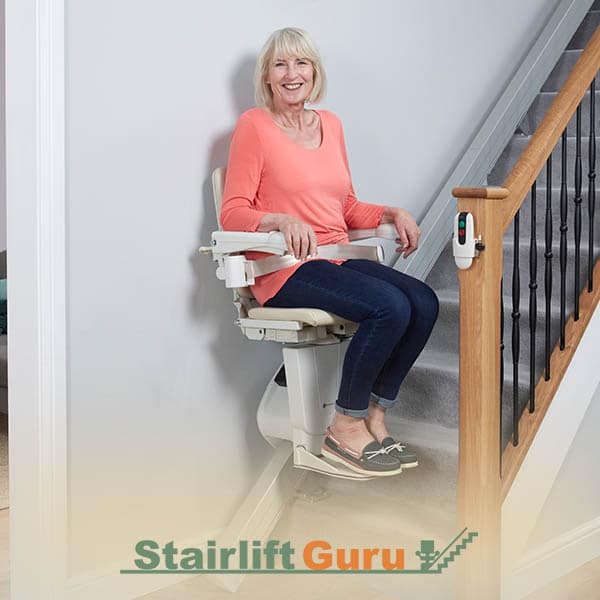
A stairlift rail (also called a track) is the long metal guide fixed to your staircase that allows the stairlift chair to travel up and down safely. The rail determines:
- What type of stairlift you can install (straight, curved, or outdoor)
- Where the stairlift can start and finish (important near doorways and hallways)
- How much space remains on the stairs for everyone else
If you’re choosing a stairlift, the rail is one of the most important parts of the system because it must be suited to your staircase layout and your day-to-day routine.
1) curved stairlifts Rails
Curved stairlift rails are designed for staircases with:
- Bends, corners, or winding sections
- Multiple landings
- Spiral or unusual stair layouts
Because every curved staircase is different, curved rails are usually custom-built using precise measurements so the stairlift follows the staircase smoothly and stops in safe positions.
Useful curved rail options
- Rail start/finish adjustments: Helps avoid blocking a doorway at the bottom or creating an awkward exit point at the top.
- Parking positions: The lift can often be parked out of the way, depending on space and layout.
- Fold-away rail ends (where needed): Useful when the rail would otherwise extend into a hallway or near a door.
Curved rails are ideal for complex staircases, but they are typically more expensive than straight rails because of the custom design and build.
2) straight stairlifts Rails
Straight stairlift rails are designed for staircases that run in a single line without turns. They’re:
- Faster to install
- Usually more affordable than curved rails
- A popular option for standard UK staircases
What matters most for straight rails
- Headroom: Ensures the user has enough clearance while travelling.
- Step height and consistency: Helps the rail sit securely and run smoothly.
- Clearance and access: Ensures others can still use the stairs comfortably.
Many straight rails come with durable, scratch-resistant finishes to hold up well in everyday use.
3) outdoor stairlifts Rails
Outdoor stairlifts use rails and fixings made specifically for external conditions. Most outdoor stairlift rails are straight, as outdoor steps are usually built without complex turns.
What outdoor rails are designed to withstand
- Rain and damp conditions
- Frost and snow
- Fog and low temperatures
- Salty air (especially near the coast)
Outdoor stairlift systems typically include weather protection for key parts and durable finishes to reduce rust and wear over time.
Where Stairlift Rails Are Fitted
Stairlift rails are normally fixed to the stair treads (not the wall), using brackets that keep the rail stable and aligned. This allows the rail to support the stairlift securely without requiring major structural changes.
What Is a Stairlift Track?
A stairlift track is simply another name for the rail. It’s the fixed pathway the stairlift chair follows as it travels up and down the stairs.
Tracks may include:
- A standard rail (straight or curved)
- Optional extensions (sometimes used to improve getting on/off safely)
- Parking points where the chair can sit out of the way when not in use
Summary: Stairlift Rails in Plain English
- Straight rails are for straight staircases and are typically simpler and cheaper
- Curved rails are custom-made to fit bends, corners, and landings
- Outdoor rails are built to withstand weather, damp, frost, and coastal air
- Rail choices affect where the lift starts/ends, how much space remains, and often the overall price
If you’re learning about different rail options, our complete stairlift advice hub covers everything you need to know before choosing the right system — stairlift advice guide.
For insight into how stairlifts actually work and what components are involved, check out how stairlifts work.
You might also find our stairlift accessories article helpful if you’re considering add-ons or upgrades for comfort and convenience.