

If you rent your home and struggle with the stairs, you might assume adaptations like stairlifts are only for people who own their property. That is not the case. With the Renters’ Rights Act 2025 now being introduced in stages through 2026, and reforms to the Disabled Facilities Grant that give more weight to renters, tenants have clearer routes than ever to make a rented home safer to live in.
Here we explain what the law says about home adaptations for tenants, how to ask a landlord for permission, where the funding comes from, and what to do if a permanent fixture is not an option.
Why this matters now
Roughly nine in ten people aged 65 and over live in ordinary housing rather than specialist accommodation, and a growing share of them are renting. According to Propertymark, almost 867,000 households headed by someone aged 55 or over now live in England’s private rented sector, a figure that is forecast to keep climbing. Yet the supply of accessible homes has not kept pace. Bungalows made up around 1 per cent of new homes built in 2024, compared with roughly 11 per cent in 1990, so many older tenants are living in properties that were never designed with mobility in mind.
Two recent developments have pushed tenant adaptations up the agenda. First, the Renters’ Rights Act 2025 received Royal Assent on 27 October 2025 and is being rolled out across 2026, with the abolition of Section 21 “no fault” evictions taking effect from 1 May 2026. Greater security of tenure makes it more realistic for renters to invest time and effort in adapting a home they can now expect to stay in. Second, the government confirmed changes to how Disabled Facilities Grant funding is allocated to councils from 2026-27, with the new formula giving more weight to local need and housing tenure, including the private rented sector.
We do not sell or install stairlifts. Quotes go to UK suppliers.
If you buy a stairlift from a supplier we introduced you to, that supplier pays us a fee. Requesting quotes is free and we are not paid for the request itself. How we are funded
Free, no obligation • UK-based suppliers only
What the law says about adaptations in rented homes
Two pieces of legislation matter most for tenants. The Equality Act 2010 places a duty on landlords, letting agents and councils to make reasonable adjustments so that disabled people can use their services. In a housing context this can include agreeing to changes that help a disabled tenant live safely at home. Importantly, the reasonable adjustments duty has limits: it does not generally require a landlord to alter or remove “physical features” of a property, such as making structural changes, removing walls or widening doorways.
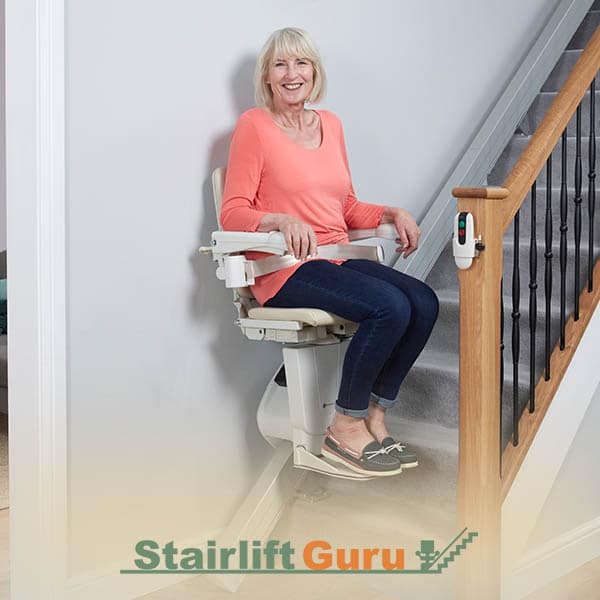
This distinction actually helps when you are thinking about stairlifts. A typical stairlift is fixed to the staircase treads rather than the wall, and it can be removed with the track taken away and the fixings made good afterwards. Because it is usually reversible and does not permanently alter the structure, it tends to sit more comfortably within what a landlord can reasonably agree to than, say, knocking through a wall. That said, every property and tenancy is different, so it is always worth getting the arrangement agreed clearly and in writing.
The Renters’ Rights Act 2025 adds to this picture by supporting reasonable requests from tenants for changes to their home, including accessibility adaptations. Landlords can still attach conditions when they agree, for example asking that the change is reversible or that the property is returned to its original state at the end of the tenancy. Getting these expectations set out in advance protects both sides.
We do not sell or install stairlifts. Quotes go to UK suppliers.
If you buy a stairlift from a supplier we introduced you to, that supplier pays us a fee. Requesting quotes is free and we are not paid for the request itself. How we are funded
How to ask your landlord for permission
The practical starting point is a clear, written request to your landlord or letting agent. It helps to explain what is being proposed, why it is needed, and to reassure the landlord about how the equipment will be installed and later removed. A short letter or email that sets out the following usually works well: what the adaptation is, who will fit it, whether it is fixed to the stairs rather than the wall, and a commitment to remove it and make good any fixings when you leave.
If an occupational therapist has assessed your needs, their recommendation carries weight and can be included with your request. Charities such as Scope and services like Citizens Advice publish free guidance on approaching a private landlord about adaptations, and can help if a request is unreasonably refused. Where a landlord agrees, ask for the permission in writing so there is no confusion later.
Funding: the Disabled Facilities Grant is open to tenants
Many people do not realise that the Disabled Facilities Grant is available to tenants as well as owner-occupiers. Administered by your local council, the grant can pay towards adaptations that help a disabled person live independently, including stairlifts, ramps and level-access showers. Tenants apply through the same route as homeowners, with the important extra step that the landlord’s consent is needed for the works.
The maximum grant in England remains capped at £30,000, and the grant is means tested for adults, so what you receive depends on your circumstances. The process usually begins with an assessment by an occupational therapist, arranged through your council’s adult social care team. Waiting times vary by area, and the 2026-27 funding changes are intended in part to widen reach and reduce delays. You can read more about eligibility and how to apply in our guide to stairlift grants in the UK.
When a permanent stairlift is not an option: renting the equipment
Sometimes buying and fitting a stairlift permanently is not the right fit, perhaps because the need is temporary, a grant is still being processed, or a landlord prefers a shorter commitment. In these situations, renting a stairlift can be a sensible middle ground. Rental agreements are typically flexible with no fixed contract, and they usually include installation, servicing and removal, which removes a lot of the uncertainty for both tenant and landlord.
Because a rented stairlift is designed to be installed and later removed, it can be easier to agree with a landlord who is cautious about longer-term changes. It also suits people recovering from surgery or waiting for a longer-term solution to be arranged. Our guide to renting a stairlift in the UK explains how the agreements work and what is included.
What tenants can do next
If you or a relative rent a home and the stairs are becoming difficult, the sensible order of action is to speak to your local council’s adult social care team about an occupational therapy assessment, put your adaptation request to your landlord in writing, and explore whether the Disabled Facilities Grant can help with the cost. If a permanent installation is not practical, rental keeps the option open without a long-term commitment. Security of tenure is improving for renters, funding routes now recognise tenants more explicitly, and the law supports reasonable adjustments, so a rented home need not stand in the way of staying safe and independent upstairs and down.
Prefer to watch? Our video guide covers the key points:
Choosing a stairlift: our six guides
Independent UK guides on every stage of the decision and the install.
- Is it time for a stairlift? , The decision before you start. Signs, conversations, and what to try first.
- Types of stairlift , Straight, curved, narrow, outdoor, heavy-duty, standing. Which one fits your home.
- Stairlift prices , What stairlifts actually cost in the UK. By type, with what changes the price.
- Stairlift grants and funding , Disabled Facilities Grant, NHS, charity, finance. Who pays for what.
- Buy, rent, or reconditioned , The three routes compared, with a decision flowchart.
- Living with a stairlift , Install, servicing, repair, batteries, sell, remove. The full lifecycle.
 ChatGPT