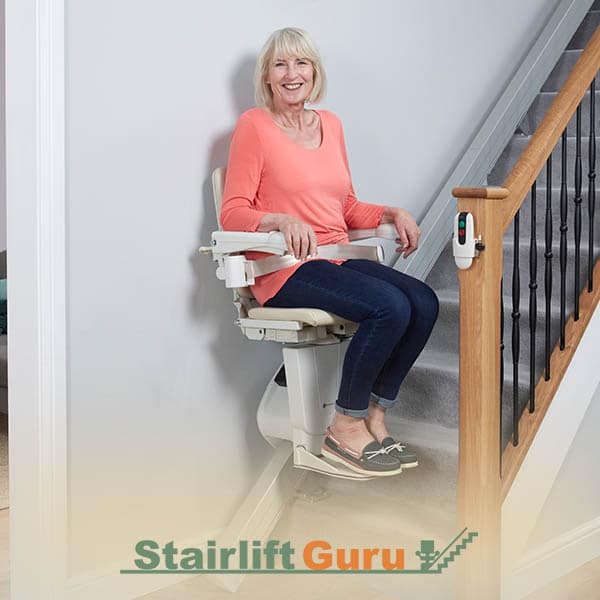
Stairlifts can be safely used on stairlifts for narrow stairss, but only when key safety considerations are properly addressed.
Limited space increases the importance of correct measurements, suitable stairlift design, and professional installation. When these factors are overlooked, safety risks can increase.
This guide explains the main safety issues with stairlifts on narrow stairs and how they are managed.
Key Takeaways
- Narrow stairs increase safety risks if poorly assessed
- Folding and slimline designs reduce hazards
- Clearance at landings is critical
- Professional installation prevents most issues
- Safety features are essential on tight staircases
1. Reduced Walking Space for Others
The risk:
On narrow stairs, a stairlift can reduce the space available for people walking up or down.
How it’s managed:
- Slimline stairlift models
- Folding seats, arms, and footrests
- Parking positions away from main walkways
Installers check that safe access remains when the stairlift is folded.
2. Mounting and Dismounting Risks
The risk:
Limited space at the top or bottom of the stairs can make getting on or off the stairlift more difficult.
How it’s managed:
- Swivel seats that turn away from the staircase
- Extended or offset rail ends for safer landings
- Careful positioning of start and stop points
Safe transfers are a top priority in narrow spaces.
3. Foot Clearance and Trip Hazards
The risk:
On narrow stairs, footrests and rails can create trip hazards if not positioned correctly.
How it’s managed:
- Compact footrest designs
- Safety edges that stop the lift if contact is made
- Precise rail placement close to the steps
These features help prevent accidents.
4. Headroom and Body Clearance
The risk:
Narrow staircases often have limited headroom, especially near turns or landings.
How it’s managed:
- Seat height and position adjustments
- Custom rail profiles
- Pre-installation headroom checks
If safe head clearance can’t be achieved, installation won’t be recommended.
5. Emergency Access and Evacuation
The risk:
A stairlift could obstruct emergency exit routes if space is too tight.
How it’s managed:
- Assessing escape routes during the survey
- Ensuring the stairlift can be folded away
- Avoiding installations that fully block the staircase
Fire safety and emergency access are always considered.
6. Structural Stress on Narrow Stairs
The risk:
Older or narrow staircases may be more sensitive to added fixings.
How it’s managed:
- Fixing rails to the stair treads, not walls
- Using appropriate brackets and fixings
- Checking step integrity before installation
Structural stability is assessed during the survey.
7. User Fit and Comfort
The risk:
If the user is too large for the seat or feels unstable, safety is compromised.
How it’s managed:
- Choosing the right seat size
- Testing user comfort during assessment
- Selecting models designed for narrow stairs
User safety always comes before fitting convenience.
How Are Safety Risks Minimized Overall?
Most risks are avoided by:
- Using experienced installers
- Carrying out a full professional survey
- Selecting a stairlift designed for narrow stairs
- Ensuring all safety features are functional
DIY fitting or poor assessments increase risk and should be avoided.
When Might a Stairlift Not Be Safe on Narrow Stairs?
A stairlift may not be safe if:
- There is no safe mounting or dismounting space
- The lift blocks the stairs entirely
- Headroom or clearance is insufficient
- Emergency access would be compromised
In these cases, alternative access solutions are recommended.
Final Verdict: Safety Issues With Stairlifts on Narrow Stairs
Stairlifts can be safe on narrow stairs when correctly designed, assessed, and installed.
Safety issues arise mainly from poor planning or unsuitable equipment, not from narrow stairs themselves.
A professional survey is essential to ensure the stairlift improves mobility without creating new risks.
If you’re thinking about safety on tight staircases, our full narrow stairs stairlifts guide explains key considerations before choosing the right solution — narrow stairs stairlifts guide.
For insight into how stairlifts fit in narrow spaces, you might find can you fit a stairlift on narrow stairs useful for understanding clearance and usability.
You could also check out stairlift installation challenges on narrow staircases if you’re planning a setup in a tighter home.