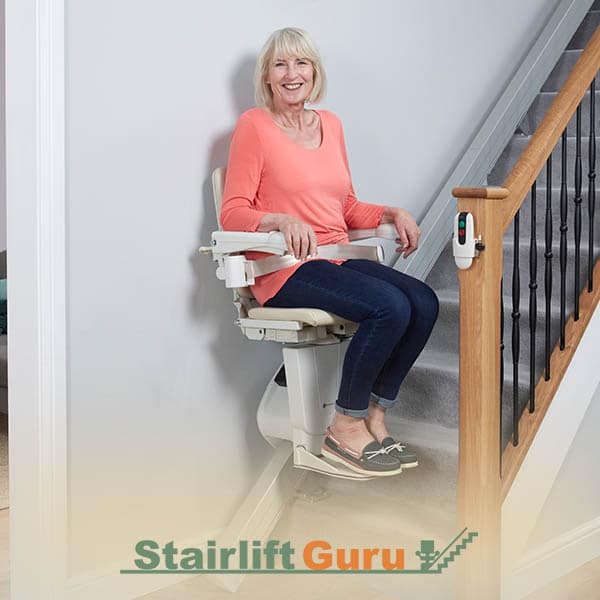
Curved stairlifts are designed for staircases with bends, turns, or landings. While they offer safe access where straight stairlifts can’t be used, they also come with some trade-offs.
This page outlines the advantages and disadvantages of curved stairlifts to help you make an informed decision.
Key Takeaways
- Curved stairlifts are essential for non-straight staircases
- They offer smooth, safe travel around bends
- They are custom-built and therefore more expensive
- Installation takes longer than straight stairlifts
- Resale options are more limited
The Short Answer: Are Curved Stairlifts Worth It?
Curved stairlifts are worth it if your staircase has bends or landings and you need safe, reliable access between floors. They are often the only suitable solution for complex staircases, but they do cost more and are custom-made.
The shape of your stairs is the deciding factor.
Advantages of Curved Stairlifts
Designed for Complex Staircases
Curved stairlifts can handle:
- Multiple turns
- Intermediate landings
- Spiral or helical staircases
They follow the exact shape of your stairs.
Smooth and Comfortable Travel
Custom rails allow:
- Gentle movement around corners
- Stable, balanced travel
- Smooth starts and stops
This improves comfort and confidence.
Safe and Reliable
Curved stairlifts include:
- Seatbelts
- Obstacle sensors
- Swivel seats
- Battery backup
These features help reduce the risk of falls.
Can Cover Multiple Floors
Some curved stairlifts can travel across:
- More than one landing
- Multiple floors in the same home
This provides continuous access.
Disadvantages of Curved Stairlifts
Higher Cost
Curved stairlifts are more expensive because:
- Rails are custom-made
- Manufacturing takes longer
- Installation is more complex
This makes them pricier than straight stairlifts.
Longer Waiting Time
From survey to installation:
- Manufacturing can take several weeks
- Delivery times vary
They aren’t a same-day solution.
Limited Resale Value
Because rails are bespoke:
- Full resale is limited
- Parts may still be reused
This affects resale options.
Not Always Suitable for Very Narrow Stairs
Although many narrow staircases can accommodate a curved stairlift, extremely tight spaces may limit options.
Curved vs Straight Stairlifts: A Quick Comparison
| Feature | Curved Stairlift | Straight Stairlift |
|---|---|---|
| Staircase type | Non-straight | Straight |
| Rail | Custom-built | Standard |
| Cost | Higher | Lower |
| Installation time | Longer | Shorter |
| Resale potential | Limited | Higher |
Are the Disadvantages a Deal-Breaker?
For many people, no. If your staircase isn’t straight, a curved stairlift may be the only safe option. The benefits often outweigh the drawbacks when safety and independence are priorities.
Get Honest Advice from Stairlift Guru
At Stairlift Guru, we help explain the pros and cons clearly so you can make a confident decision without pressure.
Is a Curved Stairlift Right for You?
If you’re weighing up whether a curved stairlift is the right solution, getting expert advice is the best next step.
We’re here to help with no obligation.
If you’re weighing up the advantages and disadvantages, our complete curved stairlifts guide covers what to consider before choosing the right model for your home.
To compare how different stairlift styles suit various layouts, check out curved vs straight stairlifts — it’s especially useful for understanding how each type fits different staircases.
You may also find our new vs reconditioned curved stairlifts article helpful when thinking about cost and condition options.