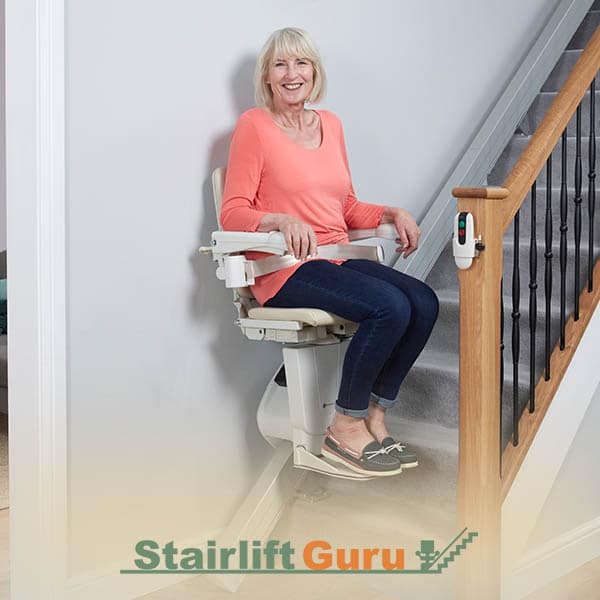
curved stairliftss are designed to move smoothly along staircases that have bends, corners, or landings. Unlike straight stairliftss, they use a custom-built rail that follows the exact shape of the stairs.
This page explains how curved stairlifts work, from design and installation to everyday use.
Key Takeaways
- Curved stairlifts use custom-made rails
- Each stairlift is built to fit one specific staircase
- They operate using rechargeable batteries
- Movement is smooth and controlled around bends
- Safety features are built into every journey
The Short Answer: How Does a Curved Stairlift Work?
A curved stairlift moves a motorised chair along a bespoke rail that follows the staircase’s curves. The rail is designed using precise measurements, allowing the chair to travel safely around corners and over landings.
The stairlift is powered by batteries, ensuring it continues to operate during a power outage.
Step-by-Step: How a Curved Stairlift Operates
1. Custom Rail Design
Before installation, the staircase is carefully measured. These measurements are used to manufacture a rail that:
- Matches the exact shape of the stairs
- Follows bends and corners smoothly
- Allows safe stopping points
2. Professional Installation
Once manufactured, the rail is installed along the stair treads, not against the wall. The chair, motor, and control system are then fitted and tested.
Installation usually takes longer than a straight stairlift due to the bespoke rail.
3. Powered Movement
The chair travels along the rail using an electric motor powered by rechargeable batteries. This ensures:
- Smooth acceleration and stopping
- Quiet operation
- Continued use during power cuts
4. Safe Travel Around Curves
The rail is designed to maintain balance and stability as the chair moves around bends. Sensors monitor movement to ensure safe travel at all times.
How Are Curved Stairlifts Controlled?
Curved stairlifts are easy to use and typically controlled by:
- A simple armrest joystick or switch
- Wall-mounted call and send buttons
These controls allow the stairlift to be moved up or down safely and at a comfortable pace.
What Safety Features Do Curved Stairlifts Have?
Curved stairlifts include multiple safety features, such as:
- Seatbelts
- Obstacle sensors
- Swivel seats for safe access
- Smooth start-and-stop technology
These features help reduce the risk of trips or falls.
Do Curved Stairlifts Take Up More Space?
Curved stairlifts are designed to fit closely to the staircase. While the rail follows the shape of the stairs, many models include:
- Folding seats
- Folding footrests
- Compact designs
This helps keep staircases usable for others.
Why Are Curved Stairlifts More Expensive?
Curved stairlifts cost more because:
- The rail is custom-built
- Manufacturing takes longer
- Installation is more complex
Each curved stairlift is made for one specific staircase.
Can Curved Stairlifts Be Removed or Reused?
Curved stairlifts can be removed professionally, but:
- The rail cannot usually be reused elsewhere
- Parts may still be refurbished or recycled
This is why resale options are more limited than for straight stairlifts.
Get Advice on Curved Stairlifts
At Stairlift Guru, we explain stairlift options clearly and honestly. Whether you’re learning how they work, considering removal, or exploring selling options, we’re here to help.
Need Help With a Curved Stairlift?
If you have questions about how curved stairlifts work or want guidance on your next steps, we’re happy to help with no pressure.
If you’re getting to grips with how these systems operate, our complete curved stairlifts guide breaks down all the key considerations before you make a choice.
For a breakdown of how different stairlift designs compare, check out curved vs straight stairlifts to see which might suit your staircase best.
You may also find our curved stairlift FAQs useful for answers to other common questions about usage and features.