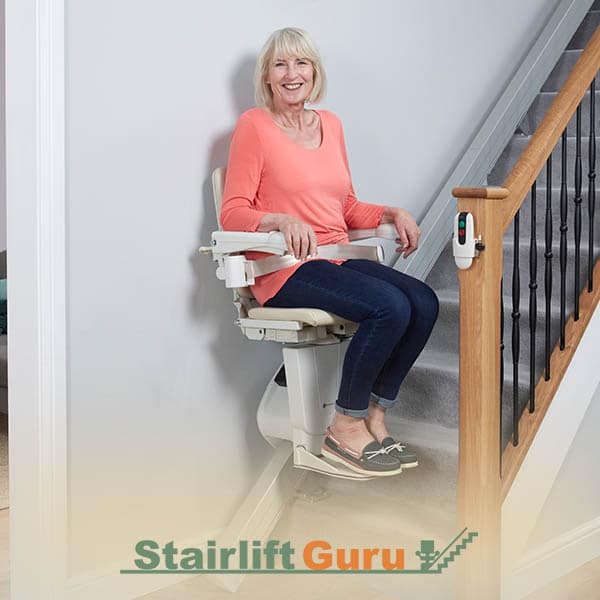
curved stairliftss are designed for staircases with bends, turns, or landings, and it’s natural to have questions before deciding if one is right for you. This FAQ page answers the most common questions about curved stairlifts in clear, simple terms.
What is a curved stairlift?
A curved stairlift is a stairlift designed to follow the shape of a staircase that isn’t straight. It uses a custom-built rail to travel safely around bends, corners, or landings.
How is a curved stairlift different from a straight stairlifts?
Straight stairlifts work only on straight staircases. Curved stairlifts are custom-made to fit staircases with turns, landings, or spiral layouts. Because of this, curved stairlifts are usually more expensive and take longer to install.
When do you need a curved stairlift?
You need a curved stairlift if your staircase:
- Has one or more bends
- Includes intermediate or half landings
- Changes direction between floors
If your staircase isn’t perfectly straight from top to bottom, a curved stairlift is usually required.
Can curved stairlifts fit stairlifts for narrow stairss?
In many cases, yes. Curved stairlifts are designed to fit closely to the staircase and often include folding seats and footrests to save space. A professional survey is needed to confirm suitability.
How long does a curved stairlift take to install?
The installation itself usually takes a few hours and is completed in one visit. However, the full process, including survey and custom rail manufacturing, can take several weeks.
Are curved stairlifts safe?
Yes. Curved stairlifts include multiple safety features such as seatbelts, obstacle sensors, smooth start-and-stop movement, and battery backup. They’re designed to meet strict safety standards.
How much do curved stairlifts cost?
Curved stairlifts cost more than straight stairlifts because the rail is custom-built. The exact price depends on staircase complexity, number of turns, and features required. A survey provides an accurate quote.
Can curved stairlifts be reconditioned stairlifts?
Yes. Some curved stairlifts can be reconditioned or refurbished, depending on availability and staircase layout. Reconditioned options are usually more affordable but may have limited customisation.
Can you sell a stairlift?
Curved stairlifts can sometimes be sold, usually for parts rather than full reuse, because the rail is custom-made. A valuation can help confirm whether selling is an option.
Can curved stairlifts be removed?
Yes. Curved stairlifts can be removed professionally. Removal is usually straightforward and doesn’t damage the staircase.
Do curved stairlifts work during a power cut?
Yes. Most curved stairlifts are battery-powered and will continue to work during a power cut.
Are curved stairlifts suitable for wheelchair users?
Curved stairlifts are designed for seated use and require transferring from a wheelchair to the stairlift seat. For full wheelchair access, a home lift or platform lift may be more suitable.
Can a curved stairlift go over more than one landing?
Yes. Curved stairlifts can be designed to travel across multiple landings or even between multiple floors, depending on the staircase layout.
How do I know if a curved stairlift is right for me?
A professional assessment is the best way to know. A surveyor can confirm whether a curved stairlift fits your staircase and meets your mobility needs.
Get More Help with Curved Stairlifts
At Stairlift Guru, we aim to explain curved stairlifts clearly and honestly, so you can make confident decisions without pressure.
Still Have Questions?
If you have questions about curved stairlifts that aren’t covered here, we’re happy to help.
Clear advice is always the best place to start.
If you’re diving into stairlift questions, our full curved stairlifts guide covers everything from features to key considerations before buying.
For help choosing between different designs, take a look at curved vs straight stairlifts — it’s useful for comparing how each type works in different homes.
You may also find our article on new vs reconditioned curved stairlifts helpful when thinking about cost and condition options.