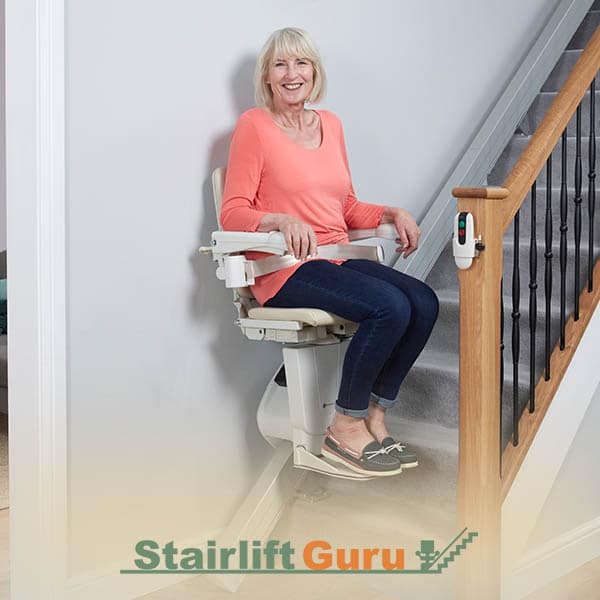
Standing stairlifts can be installed in many homes, but they require specific installation requirements to ensure safe use.
Because users remain upright or semi-upright during travel, correct spacing, support, and staircase layout are especially important.
This guide explains the key installation requirements for standing stairlifts and what installers look for during a professional survey.
TL;DR:
Standing stairlifts can be installed in many homes, but only if the staircase has enough width, clearance, landing space, and headroom, and the user can stand safely and confidently. A professional survey is essential, as not all staircases or users are suitable, and safety always comes first.
1. Minimum Stair Width and Clearance
The requirement:
Standing stairlifts need enough usable stair width to allow:
- Safe standing position
- Room for folding components
- Continued access for others
What installers check:
- Stair width at multiple points
- Clearance when the stairlift is folded
- Narrowest sections of the staircase
Standing stairlifts often fit where seated stairlifts do not, but safety clearance must still be met.
2. Landing Space at Top and Bottom
The requirement:
Safe mounting and dismounting areas are essential.
What installers check:
- Space to step on and off safely
- Ability to turn or move away from the stairs
- Risk of stepping directly onto a stair edge
Features like swivel platforms or offset rail ends may be used to improve safety.
3. Staircase Shape and Layout
The requirement:
Standing stairlifts can be installed on:
- Straight staircases
- Curved or winding staircases
What installers check:
- Stair angle and steepness
- Turns, winders, and landings
- Headroom clearance
Curved installations require bespoke rails and careful planning.
4. User Balance and Stability
The requirement:
The user must be able to:
- Stand steadily for the duration of the journey
- Hold support rails or armrests
- Step on and off safely
Installers assess user stability before confirming installation.
5. Structural Condition of the Stairs
The requirement:
Stairs must be structurally sound to support the rail and brackets.
What installers check:
- Step integrity
- Material condition (wood, concrete, etc.)
- Fixing points for brackets
Minor repairs may be recommended before installation.
6. Headroom and Body Clearance
The requirement:
Users must have adequate head and shoulder clearance during travel.
What installers check:
- Ceiling height along the staircase
- Clearance near turns or landings
- User height and posture
Insufficient headroom may rule out installation.
7. Power Supply and Charging Points
The requirement:
Standing stairlifts usually operate on batteries charged from a standard power supply.
What installers check:
- Nearby electrical sockets
- Charging point placement
- Safe cable routing
Battery operation ensures continued use during power cuts.
8. Safety Features and Controls
The requirement:
Standing stairlifts must include:
- Safety belt or harness
- Obstruction sensors
- Smooth start and stop controls
- Easy-to-use controls
Installers test all safety systems before handover.
Why a Professional Survey Is Essential
A professional survey ensures:
- The stairlift fits safely
- The user can use it confidently
- Clearance and access are maintained
- Installation meets safety standards
Installers will not proceed if safety requirements cannot be met.
When Standing Stairlifts May Not Be Suitable
Installation may not be recommended if:
- The user cannot stand safely
- Stair width or headroom is insufficient
- Landings are too small for safe transfers
- Structural integrity is poor
Alternative solutions may then be advised.
Final Verdict: Installation Requirements for Standing Stairlifts
Standing stairlifts can be installed safely when key space, stability, and structural requirements are met.
They are especially useful for narrow staircases, but only when the user can stand confidently and the staircase provides adequate clearance.
A professional assessment is essential to confirm suitability and safety.