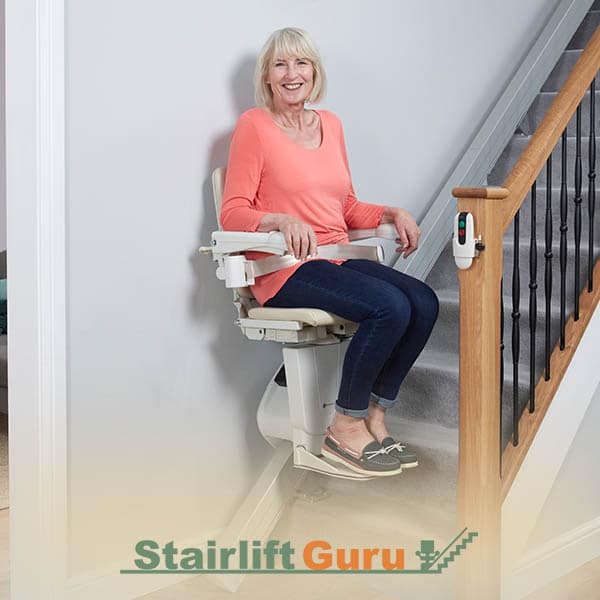
Standing and seated stairlifts serve different mobility needs.
Standing stairlifts are designed for users who struggle to sit but can stand safely, while seated stairlifts are the most common option and suit users who need full support while travelling up and down the stairs.
This guide compares standing stairlifts vs seated stairlifts to help you decide which is the safer and more practical choice.
TL;DR:
Standing stairlifts suit people who can stand safely but find sitting painful, often working well on narrow stairs. Seated stairlifts provide full support and are the safest, most suitable option for most users. The right choice depends on balance, comfort, staircase space, and future mobility needs, with a professional assessment being essential.
What Is a Standing Stairlift?
A standing stairlift uses a perch or leaning seat rather than a full chair.
Key features include:
- Upright or semi-standing travel position
- Support handles or armrests
- Safety belt or harness
- Compact design for narrow stairs
They reduce the need to bend knees or hips.
What Is a Seated Stairlift?
A seated stairlift is the traditional stairlift design.
Key features include:
- Full seat with backrest
- Armrests and footrest
- Swivel seat for safe dismounting
- Suitable for a wide range of users
They provide maximum support and comfort.
Comfort Comparison
Standing Stairlifts
- Avoid pressure on hips and knees
- Comfortable for short journeys
- Less suitable for users who tire easily
Seated Stairlifts
- Offer full body support
- More comfortable for longer journeys
- Better for users with limited strength or balance
Comfort choice depends on physical ability.
Safety Comparison
| Feature | Standing Stairlift | Seated Stairlift |
|---|---|---|
| Requires good balance | Yes | No |
| Full body support | No | Yes |
| Safety belt | Yes | Yes |
| Obstruction sensors | Yes | Yes |
Standing stairlifts are safe only for suitable users, while seated stairlifts are safer for a wider range of needs.
Staircase Width and Space
Standing Stairlifts
- More compact
- Often better for narrow stairs
- Fold away neatly
Seated Stairlifts
- Require more space
- Slimline models help on narrow stairs
Staircase width often plays a key role in the decision.
Who Should Choose a Standing Stairlift?
Standing stairlifts are best for:
- People with knee or hip pain
- Users who find sitting painful
- Homes with very narrow stairs
- Users with good balance and leg strength
Who Should Choose a Seated Stairlift?
Seated stairlifts are best for:
- Users with poor balance
- People who tire easily
- Those who need full support
- Long-term or progressive mobility needs
They are the safest option for most users.
Cost Differences
Costs vary, but:
- Standing stairlifts are often similar in price to seated stairlifts
- Curved versions of either type cost more
- Installation complexity affects price more than seat type
Price should be considered alongside safety and comfort.
How Do You Choose the Right Option?
A professional assessment considers:
- Ability to stand or sit safely
- Balance and strength
- Staircase width and shape
- Landing space
- Future mobility needs
This ensures the stairlift improves mobility without increasing risk.
Final Verdict: Standing Stairlifts vs Seated Stairlifts
Standing stairlifts are ideal for users who can stand safely but struggle to sit, while seated stairlifts are the safest and most versatile option for most people.
The right choice depends on physical ability, staircase layout, and long-term needs not just space or cost.
A professional survey is essential to confirm suitability.