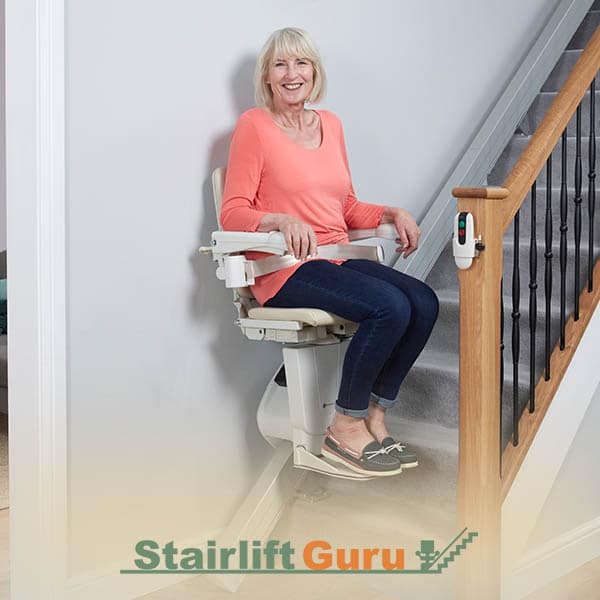
Installing a stairlift on narrow stairs is often possible, but it comes with specific challenges that require careful planning and professional expertise.
Limited space affects measurements, safety clearances, and stairlift choice, which is why narrow-stair installations must be assessed more thoroughly than standard staircases.
This guide explains the main challenges of installing stairlifts on narrow stairs and how they are typically overcome.
Key Takeaways
- Narrow stairs require precise measurements
- Space constraints affect stairlift model choice
- Clearance at landings is a common challenge
- Folding and slimline designs reduce impact
- Professional surveys are essential
1. Limited Usable Stair Width
The challenge:
Narrow stairs reduce the space available for the stairlift and for people walking on the stairs.
How it’s addressed:
- Using slimline stairlift models
- Mounting rails close to the step edges
- Selecting compact seats and footrests
Installers focus on usable width rather than overall stair width.
2. Clearance at Top and Bottom Landings
The challenge:
Insufficient space at landings can make mounting and dismounting unsafe.
How it’s addressed:
- Swivel seats to turn away from the stairs
- Extended or offset rail ends
- Custom stop points for safer transfers
Landing safety is one of the most critical considerations.
3. Folding Space Constraints
The challenge:
On narrow stairs, even folded stairlifts may obstruct movement.
How it’s addressed:
- Fully folding seats, arms, and footrests
- Selecting models with minimal folded projection
- Parking the stairlift away from main walkways
This helps maintain access for others.
4. Rail Placement Limitations
The challenge:
There is less flexibility in where rails can be positioned.
How it’s addressed:
- Precise rail alignment along the stair treads
- Bespoke rail profiles where needed
- Adjusting bracket spacing to suit step depth
Correct rail placement prevents trip hazards and instability.
5. Headroom and Clearance Issues
The challenge:
Narrow stairs often coincide with reduced headroom, especially near turns.
How it’s addressed:
- Adjusting seat height and angle
- Custom rail routing
- Pre-installation headroom checks
If safe head clearance isn’t possible, installation may not proceed.
6. Maintaining Emergency Access
The challenge:
A stairlift must not block escape routes in an emergency.
How it’s addressed:
- Ensuring sufficient clearance when folded
- Avoiding full obstruction of the staircase
- Assessing fire safety during the survey
Safety regulations take priority over installation convenience.
7. Staircase Condition and Structure
The challenge:
Older narrow staircases may have worn or uneven steps.
How it’s addressed:
- Structural checks before installation
- Minor repairs if needed
- Using appropriate fixings for the stair material
Stairlifts are fixed to steps, so step integrity is crucial.
Why a Professional Survey Is Essential
A professional survey assesses:
- Stair width at multiple points
- Clearance with the stairlift folded and unfolded
- User size, mobility, and needs
- Safety at landings and along the run
This ensures the stairlift is both safe and practical.
When Narrow Stairs May Be Unsuitable
Installation may not be recommended if:
- Safe clearance cannot be maintained
- The stairlift would fully block the stairs
- Emergency access would be compromised
- User safety cannot be ensured
Alternative access solutions may then be suggested.
Final Verdict: Narrow Stairs Stairlift Installation Challenges
Installing a stairlift on narrow stairs is possible in many homes, but it requires specialist planning and the right equipment.
The main challenges are space, clearance, and safety, which can usually be managed with slimline designs and professional installation.
A thorough survey is the key to a safe, successful installation.