If you’re thinking about a stairlift, one of the first decisions you’ll face is whether you need a straight stairlift or a curved stairlift. Both provide safe, comfortable access between floors but they’re designed for different staircase shapes and user needs.
This page compares straight and curved stairlifts so you can understand the differences and choose the right solution for your home.
Key Takeaways
- Straight stairlifts are for staircases that go straight up with no bends.
- Curved stairlifts are for staircases with bends, landings, or turns.
- Straight stairlifts are usually cheaper and faster to install.
- Curved stairlifts are custom-built to fit your staircase.
- The shape of your staircase is the biggest factor in choosing between them.
The Short Answer: Which One Do You Need?
- Choose a straight stairlift if your staircase is a single continuous line with no bends or landings.
- Choose a curved stairlift if your staircase has any curves, landings, or direction changes.
Your staircase shape determines the practical solution.
What Is a Straight Stairlift?
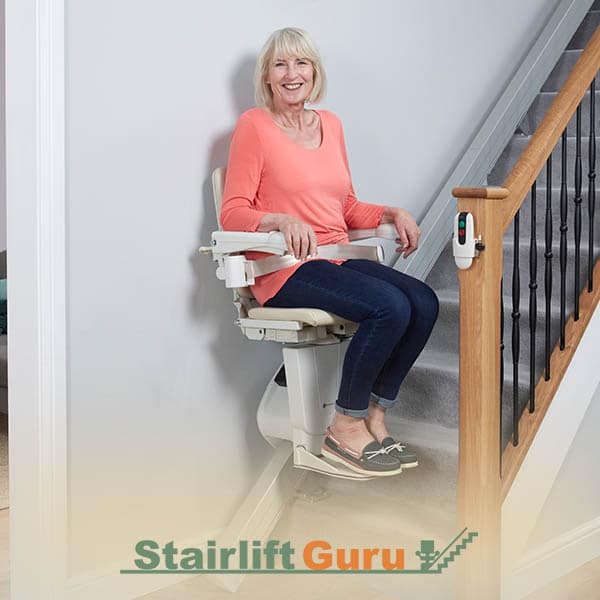
A straight stairlift runs along a standard, straight rail from the bottom to the top of the stairs. It’s a common, reliable solution for homes with simple stair layouts.
Best for:
✔ Straight staircases with no bends
✔ Quick, cost-effective installation
✔ Higher resale and easier removal
Limitations:
✘ Cannot handle landings or bends
What Is a Curved Stairlift?
A curved stairlift uses a bespoke rail designed to follow every bend, turn, or intermediate landing in a staircase. Each rail is tailor-made, making installation more involved and costlier.
Best for:
✔ Staircases with turns or landings
✔ Properties with unique layouts
✔ Seamless travel around changes in direction
Limitations:
✘ Higher cost than straight rails
✘ Longer manufacturing and lead times
Side-by-Side Comparison
| Feature | Straight Stairlift | Curved Stairlift |
|---|---|---|
| Staircase type supported | Straight only | Bends, landings, turns |
| Rail | Standard | Custom-built |
| Installation time | Shorter | Longer |
| Cost | Lower | Higher |
| Lead time | Often quick | Weeks (custom rail) |
| Resale value | Usually higher | Limited (custom rail) |
| Suitability | Most common staircases | Complex staircases |
Cost & Installation Time
Straight Stairlift
- Cost: Lower
- Installation: Typically 2–4 hours
- Timeline: Often within days
Curved Stairlift
- Cost: Higher (custom rail)
- Installation: A few hours once rail arrives
- Timeline: Weeks due to bespoke manufacturing
Space & Practical Use
Straight stairlifts fit closely to the stairs and usually fold away compactly, leaving space for others.
Curved stairlifts also fold up but may occupy slightly more space because of the bespoke rail shape required around turns and landings.
In both cases, professional surveys ensure adequate clearance and safety.
Safety & Daily Use
Both types include essential safety features such as:
- Seatbelts
- Obstacle sensors
- Smooth start/stop motion
- Battery backup (works during power cuts)
Functionally, both provide secure day-to-day access with easy controls.
Resale & Removal
Straight stairlifts are often easier to remove and have better resale potential because the rail is standard. Curved stairlifts are more bespoke, which limits full reuse though parts may still be valuable.
Professional removal ensures no damage to the stairs and preserves the property for future use.
Which Is Right for You?
- Choose a straight stairlift if your staircase runs straight and you want a reliable, affordable option.
- Choose a curved stairlift if your staircase changes direction and you need a tailored solution.
If you’re unsure which type your staircase needs, a professional assessment will confirm the right choice.
Get Expert Guidance
At Stairlift Guru, we help you understand stairlift types clearly and honestly so you can make a confident decision with no pressure.
Ready to Compare Straight and Curved Options?
If you’re deciding between a straight or curved stairlift, getting expert advice is the best next step.
We’re here to help with no obligation.